Most gym banner decisions are made reactively—a championship is won, a budget is found, a vendor is called. Three years later, the ceiling is full, the ladder fee adds up, and the team that won conference in 2019 shares the same visual weight as the squad that took state. This guide brings a planning lens to school gym banners: what recognition earns permanent wall space, what should cycle seasonally, and what belongs on a digital display where it can be found, searched, and updated without scaffolding or a screen-printing order.
Walk into almost any athletic gymnasium—middle school, high school, or small college—and you will find the same archaeology problem. Championship banners from five years ago hang above banners from fifteen years ago, printed in colors that no longer quite match the school’s current palette. Somewhere near the scoreboard, a banner recognizing a booster sponsor covers half a state-title banner from a decade past. The effect is visual noise rather than genuine celebration.
Athletic directors and school administrators managing these spaces often feel caught between tradition and practicality. Removing a banner feels disrespectful. Adding one when the rafters are already packed is expensive and logistically difficult. And none of it solves the deeper problem: the recognition that matters most to current students, families, and visiting recruits—individual records, this season’s roster, recent hall of fame inductees—is either absent or displayed so high it cannot be read.

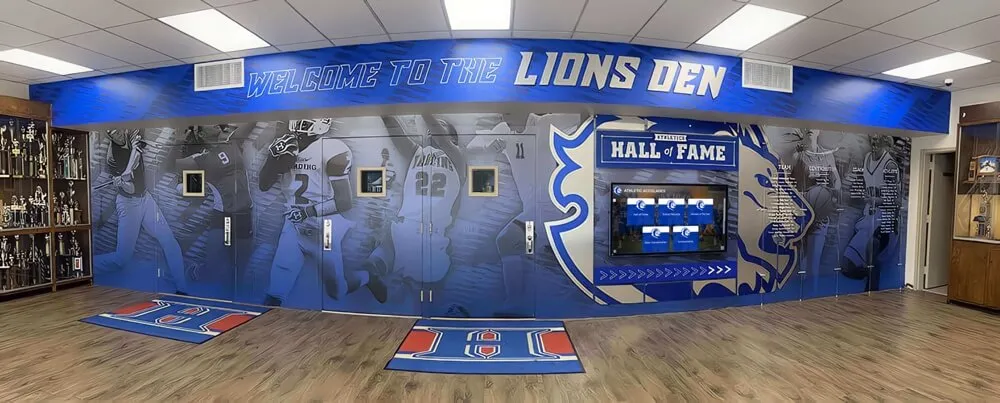
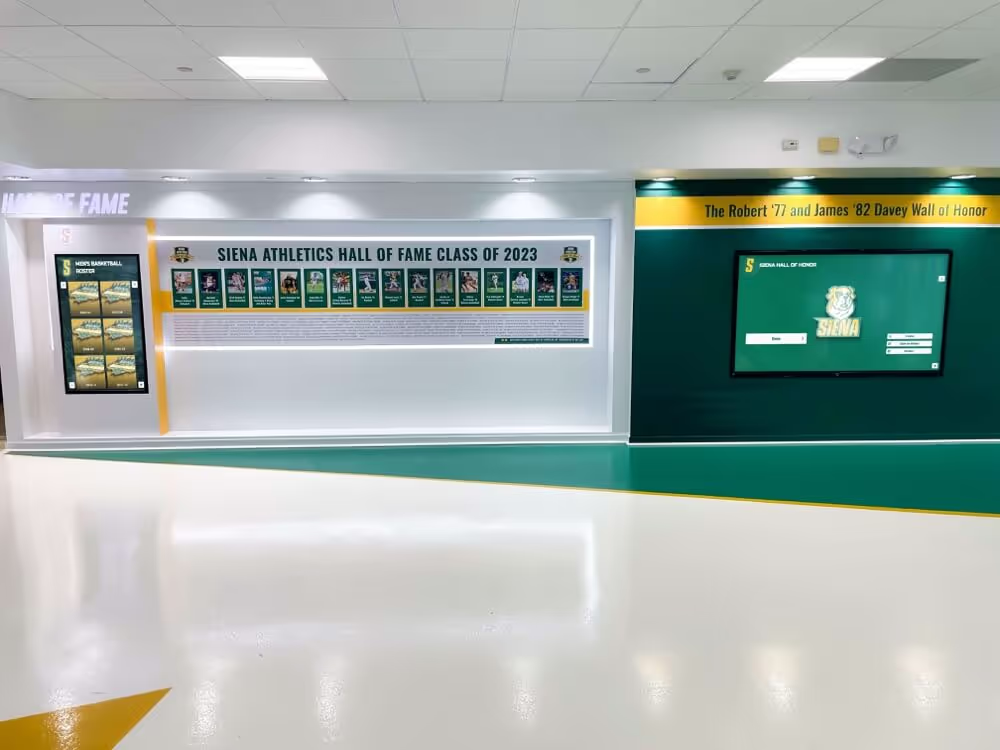
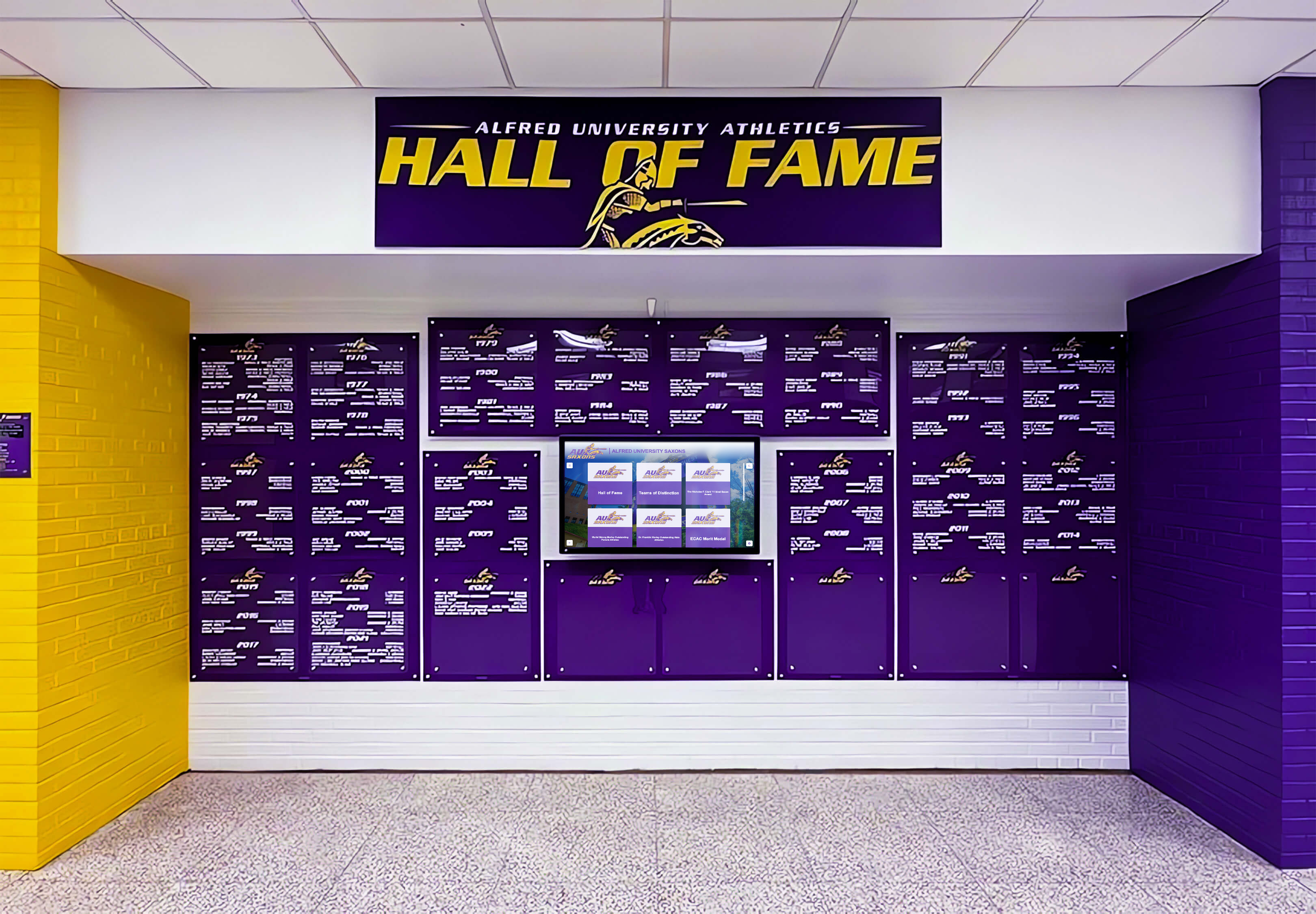
Well-designed recognition spaces pair physical branding with organized content that visitors can actually engage with at eye level
The answer is not to eliminate gym banners. It is to use them for what they do best—providing permanent, visible identity and milestone markers—while routing every other recognition category to the medium that handles it better.
Why School Gym Banners Still Matter
Before sorting recognition into categories, it is worth being clear about what physical banners accomplish that no screen replicates easily.
A championship banner hung under the rafters signals permanence. It was here before today’s student-athletes arrived, and it will be here after they graduate. That longevity communicates institutional pride and historical depth in a way that even the best digital display does not, simply because screens are understood as changeable. When a recruit walks into a gym and looks up at twenty-five years of conference championship banners, the message is not just “we win often”—it is “winning here is tradition.”
High school gym banners and custom gym banners also serve a spatial function. They fill vertical space in tall facilities where walls do not reach the ceiling and where the eye naturally travels upward during breaks in play. A well-designed banner program gives a gymnasium its visual identity even before anyone reads a single word.
That is the appropriate job for physical banners: identity, permanence, and milestone signaling at ceiling height. Everything else—the kind of recognition that benefits from being readable, searchable, updatable, and inclusive of more athletes—is a candidate for a different medium.
Category One: What to Hang Permanently
These recognition types belong on physical school gym banners because they are definitional moments in a program’s history. They are not going to change, they represent genuine institutional milestones, and their permanence on the wall communicates something important.
State and National Championships
State championships are the clearest case for a permanent banner. They represent the highest level of competition in a sport at a given level, and no subsequent season changes what that accomplishment meant. A state title from 1998 deserves the same permanent recognition as one from last spring.
If your gymnasium ceiling space is limited, state and national championships should be the last category you consider moving off physical display. Families, alumni, and visiting opponents all understand what that banner means instantly, without explanation.
Retired Jersey Numbers
When a school formally retires a jersey number, a physical banner or mounted display recognizing that player and number is appropriate because the retirement itself is permanent. The number will not be reissued; the recognition should reflect that finality. These work well as smaller banners or framed displays positioned at eye level near trophy cases rather than ceiling-height installations.
Mascot, Spirit, and Identity Banners
Gym banners and flags that display the school mascot, team name, or school colors in oversized format serve a different purpose from championship recognition—they create the visual environment that frames every game. These are worth investing in as large-format, high-quality pieces and replacing only when branding changes or materials deteriorate significantly.
Program-Defining Conference Championships
For programs with deep traditions in particular sports, select conference championships may warrant permanent banners, especially early titles that established the program’s identity or consecutive runs that represent a dynasty period. The standard here is whether the accomplishment is a genuine reference point in the program’s story, not simply whether it was a good year.
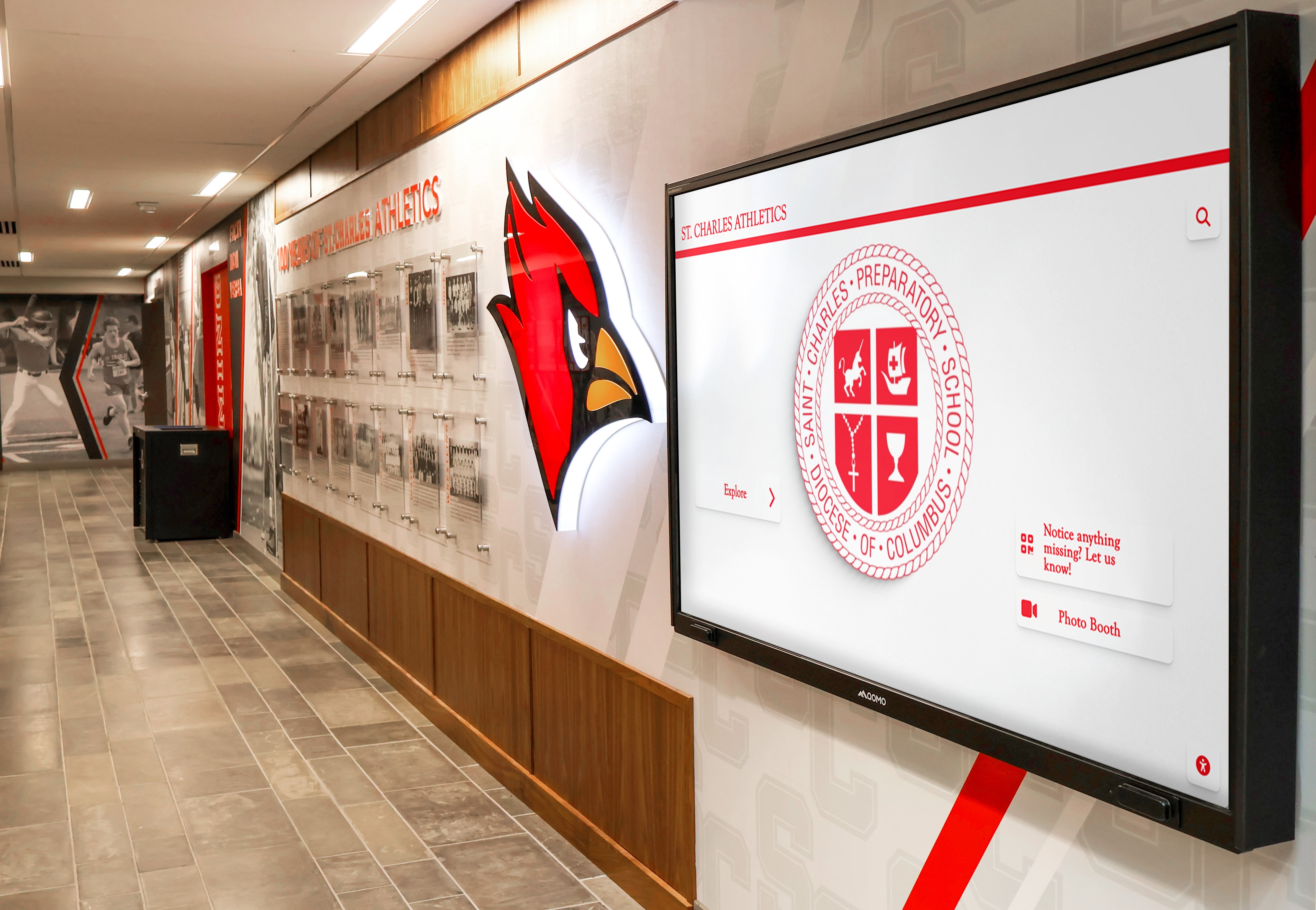
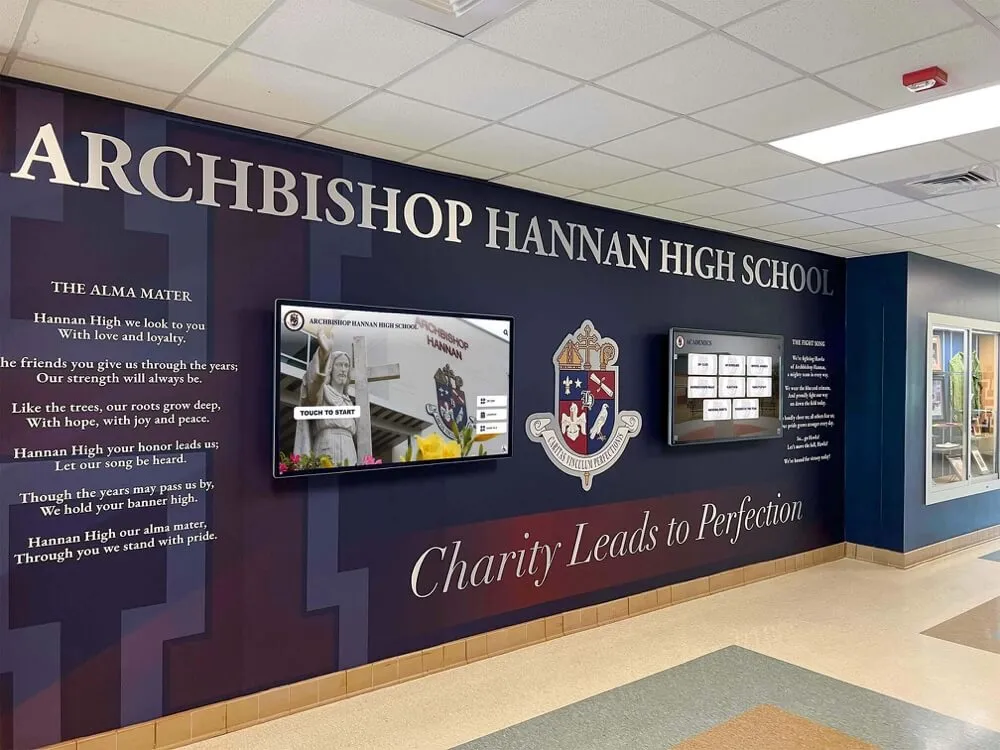
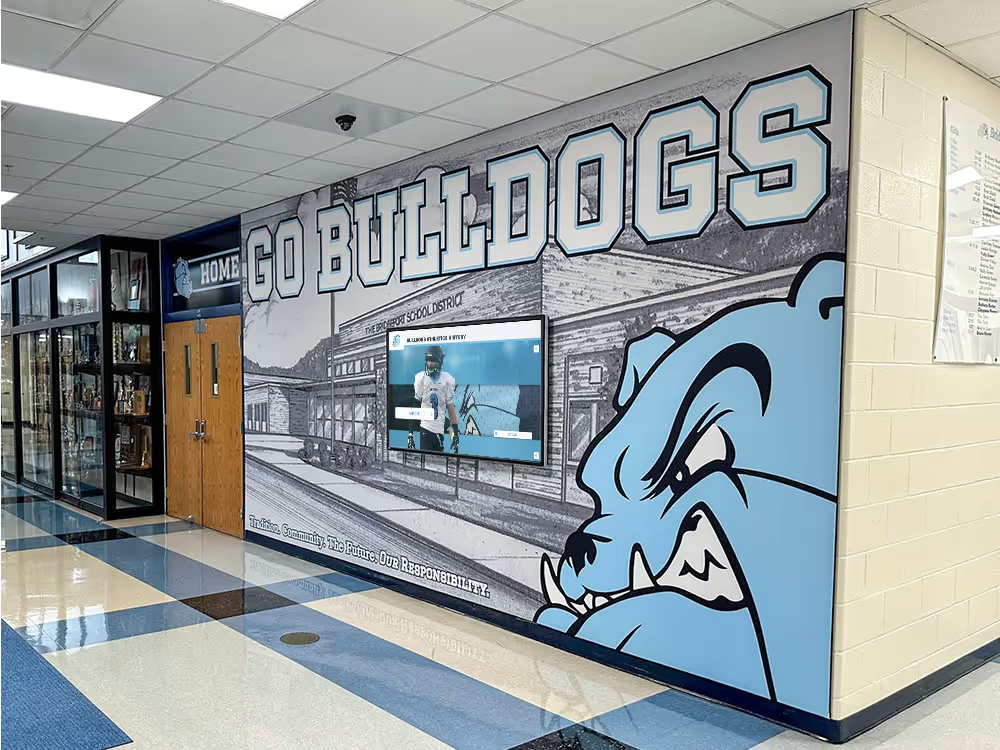
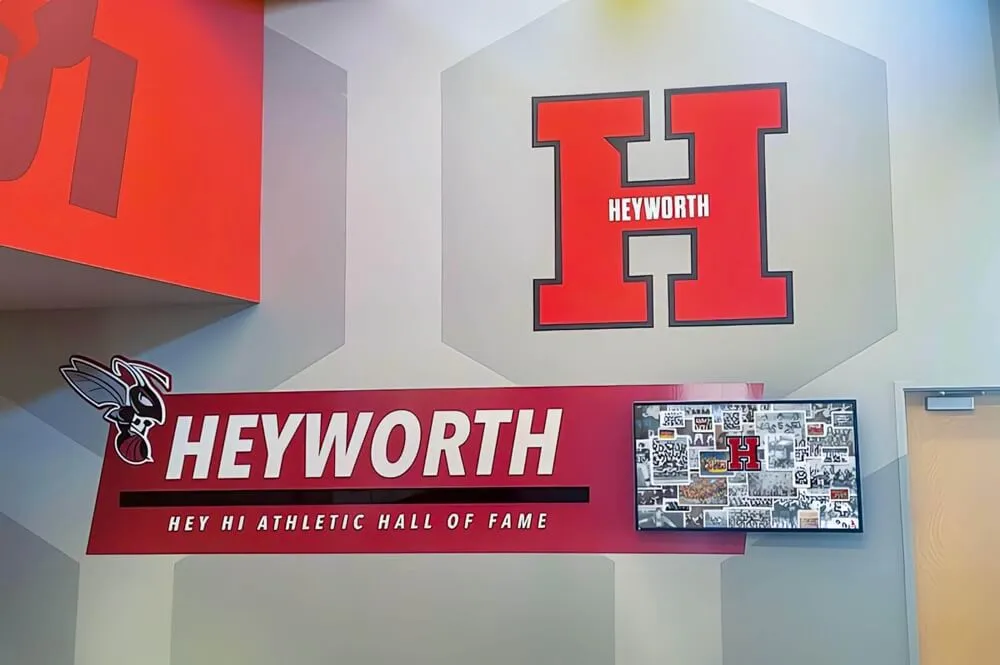
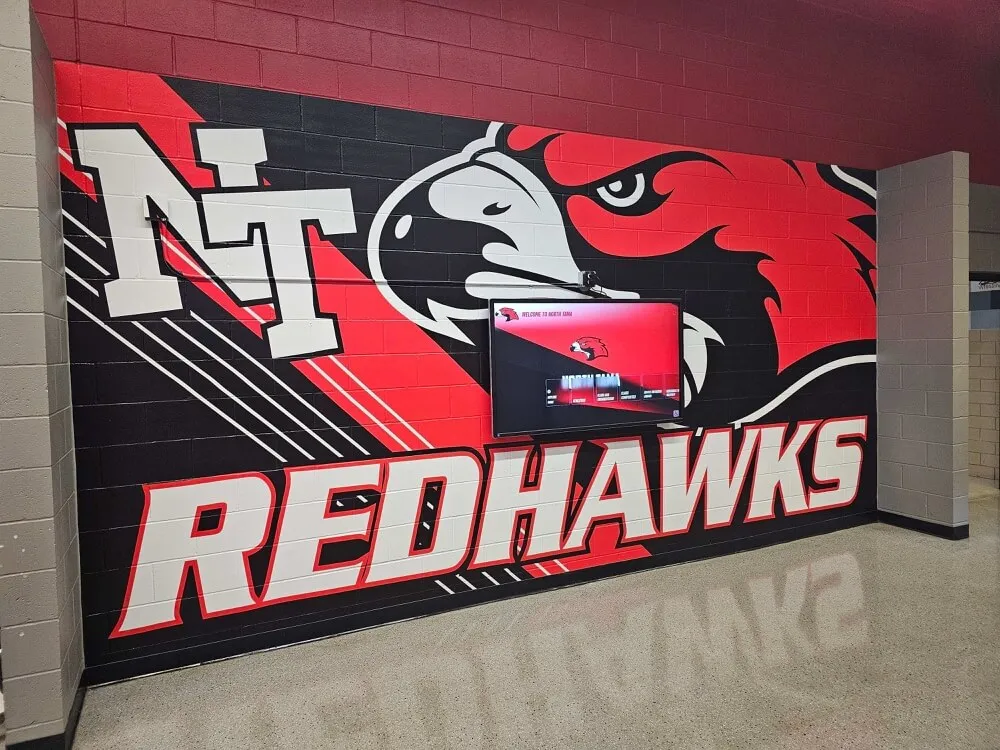
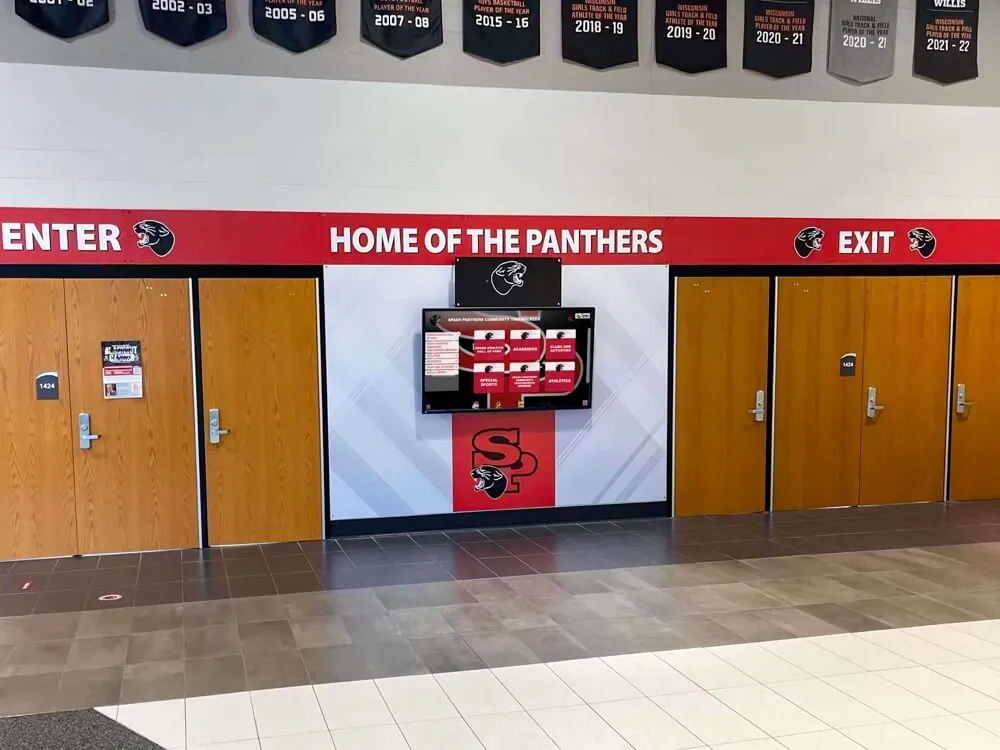
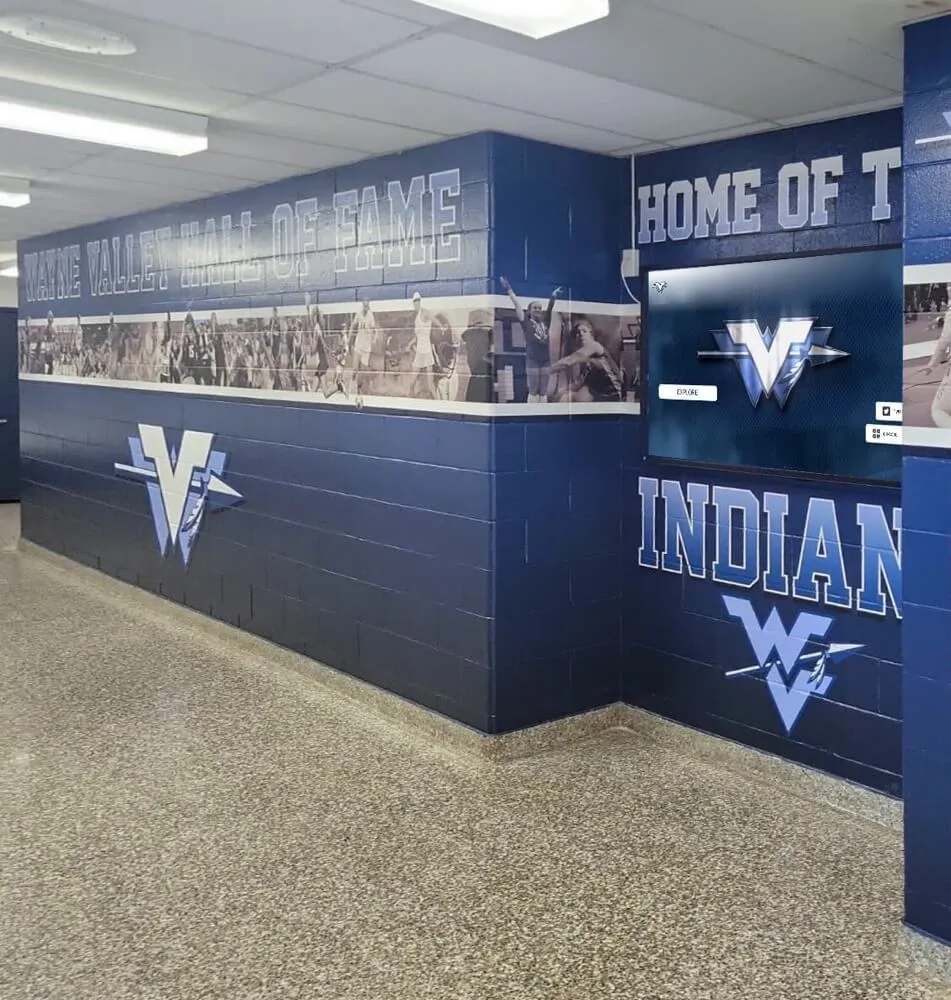
Mascot and identity elements anchor the visual space while digital displays handle the content that changes and grows over time
Category Two: What to Rotate
Some recognition content is genuinely time-bound. Displaying it permanently creates clutter; removing it entirely wastes an opportunity. Rotating recognition—displayed for a season or a year, then archived—belongs in a middle category.
Current Season Schedules and Results
Season schedules change every year. Displaying last year’s schedule on a banner is not recognition—it is out-of-date information. But a well-designed current-season display in a prominent gymnasium location serves visitors, students, and families who want to know when the next home game is. These work well as pull-up banners, digital print-on-fabric displays, or—increasingly—as content on a digital screen positioned near the entrance where it can be updated throughout the season.
Senior Athlete Spotlights
Many programs feature graduating seniors with signage during their final home season. These displays build community energy around senior nights and create meaningful recognition for athletes who may not appear on a state championship banner. Because this recognition is seasonal by definition, fabric banners or portrait displays that rotate annually are appropriate. Some programs photograph these displays and archive them digitally, giving seniors a permanent record while keeping physical displays fresh.
Current Coaching Staff and Roster Recognition
Coaching staff and roster displays help visitors connect names to faces during games and events. These change with every season and occasionally mid-season, making them poor candidates for permanent signage. Rotational displays—updated at the start of each season—work well here.
Tournament Appearances and Playoff Records
Not every tournament appearance warrants a permanent banner, but acknowledging playoff runs in the current season creates energy and communicates program competitiveness. These displays work best as temporary installations that celebrate the current moment rather than claims on permanent ceiling space.
The Gym Banner Planning Table
This quick-reference table applies the three-category framework across common recognition types. Use it when evaluating what to commission as custom gym banners, what to cycle seasonally, and what to route to a digital display.
| Recognition Type | Hang Permanently | Rotate Seasonally | Move to Digital |
|---|---|---|---|
| State and national championships | ✓ | ✓ archive | |
| Mascot and school identity banners | ✓ | ||
| Retired jersey numbers | ✓ | ✓ profile | |
| Conference championships (program-defining) | ✓ select | ✓ full list | |
| Current season schedule and results | ✓ | ✓ | |
| Senior athlete spotlights | ✓ | ✓ archive | |
| Active roster and coaching staff | ✓ | ✓ | |
| Tournament appearances and playoff runs | ✓ | ✓ | |
| All-state and all-conference selections | ✓ | ||
| Individual athletic records | ✓ | ||
| Hall of fame inductees | ✓ highlight | ✓ full archive | |
| Academic honor rolls | ✓ | ||
| Donor and booster recognition | ✓ | ||
| Multi-sport individual career achievements | ✓ | ||
| Historical program statistics | ✓ | ||
| Sponsorship and partner recognition | ✓ |
The pattern in this table reflects a principle: physical banners communicate permanence and identity best when they are selectively used. The more categories you try to hang from the ceiling, the less any individual banner means. Digital displays, by contrast, grow more valuable as they accumulate more content—an archive of five hundred individual achievements is more useful than an archive of five.
Category Three: What to Move to a Digital Display
The recognition categories in the third column of the table share a common characteristic: they benefit from being readable, searchable, updatable, or numerous. Physical school gym banners cannot do any of those things effectively.
Individual Athletic Records and Record Boards
A record board showing the school’s top marks in every event is one of the most referenced pieces of athletic recognition in any gymnasium—coaches use it for goal-setting conversations, athletes compare their performances, and parents reference it during recruitment discussions. But a traditional fixed record board requires manual updates, often falls behind by a season or two, and cannot link to context like athlete profiles or historical progressions.
Digital record boards update automatically when new marks are entered, can display historical record progressions, and allow visitors to explore which athletes hold which records across every sport and event. Platforms reviewed in roundups of best hall of fame tools for athletics programs often include record board functionality as part of broader athletic recognition systems.
All-State and All-Conference Selections
Programs that consistently produce all-state athletes accumulate these selections faster than any physical wall can absorb them. A school with fifteen sports, each naming all-state representatives annually, generates twenty or more individual honorees per year. Over a decade, that is two hundred athletes whose all-state recognition deserves visibility.
Digital displays handle this scale comfortably. Each honoree receives a profile with their photo, sport, year, and distinction. Filters let visitors browse by sport or by year. The 2015 all-state swimmer and the current all-conference basketball player appear with equal clarity and equal detail.
For broader ideas about how schools structure individual athletic recognition, collections of youth sports award ideas provide useful frameworks for categorizing achievement types beyond championship banners.
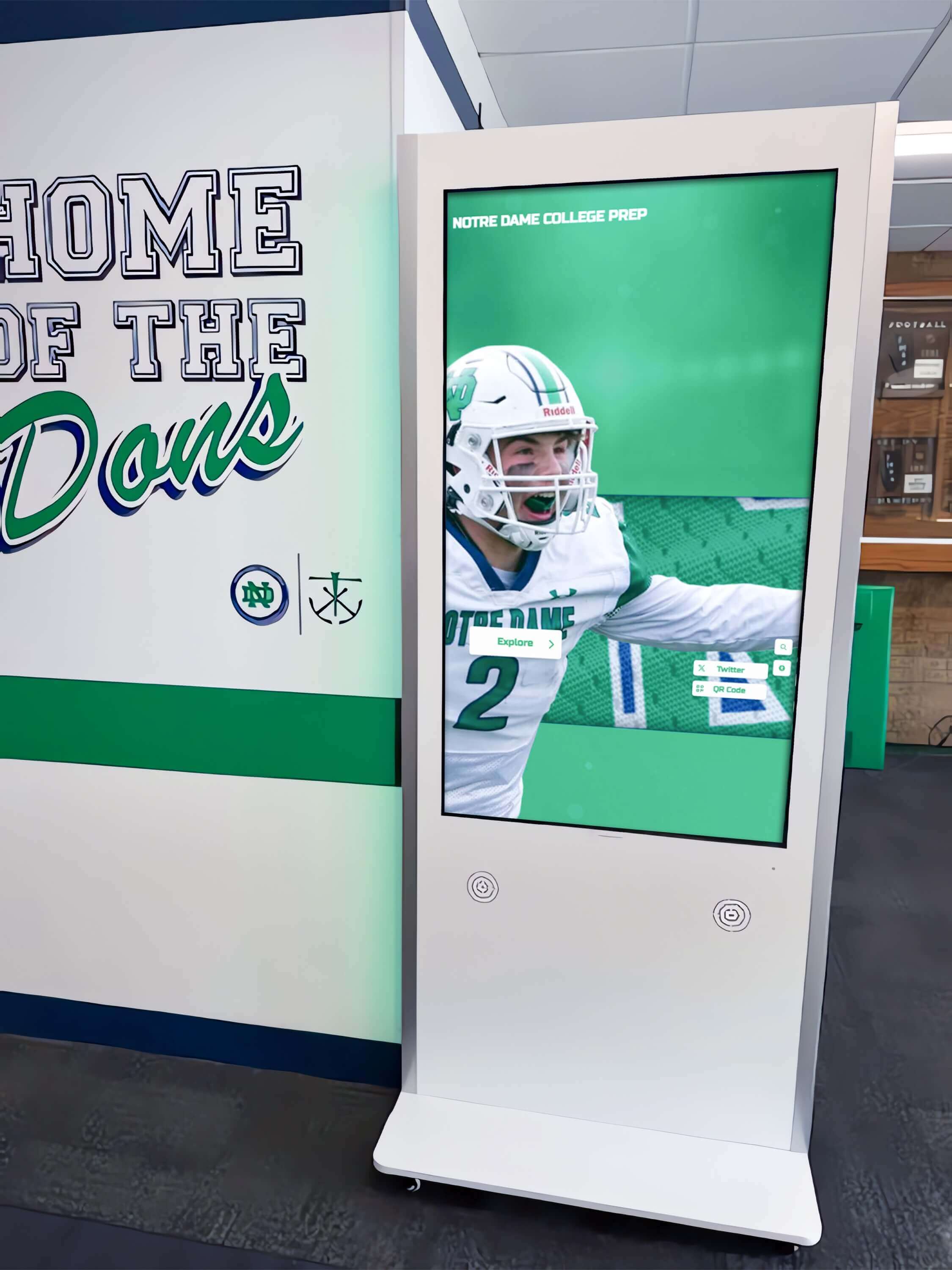
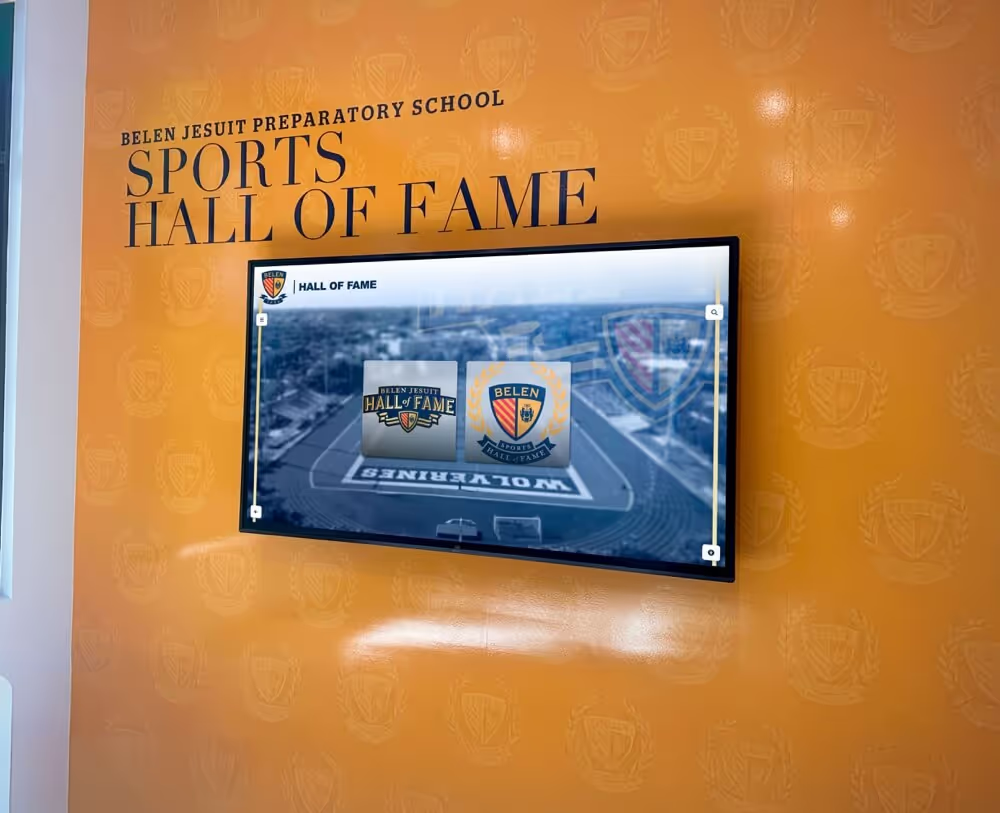
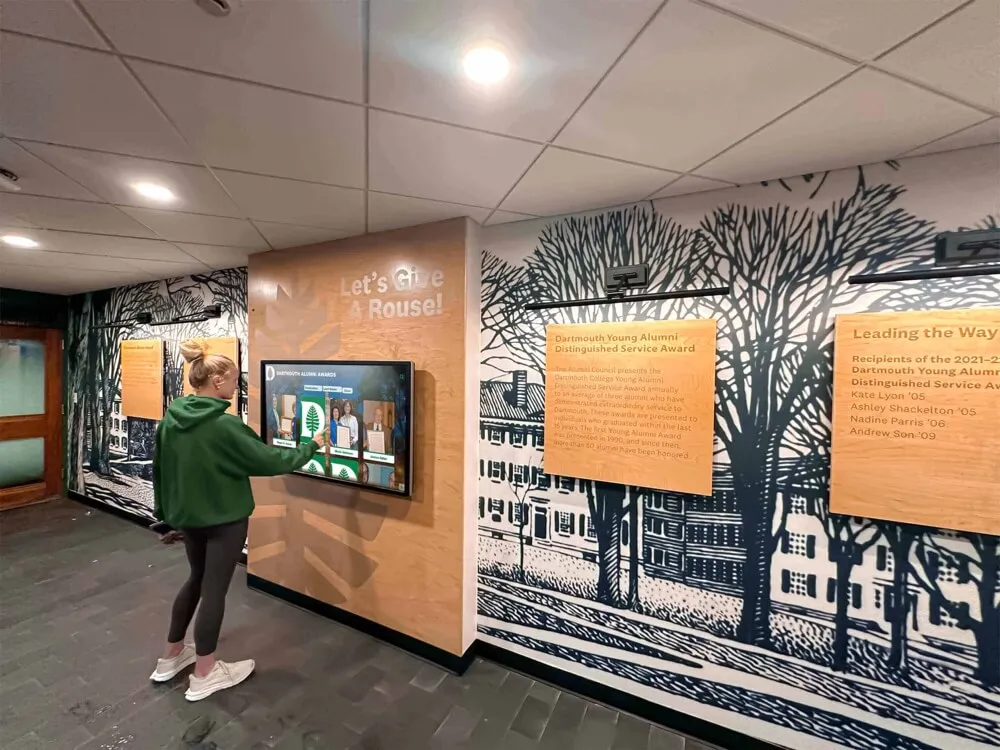
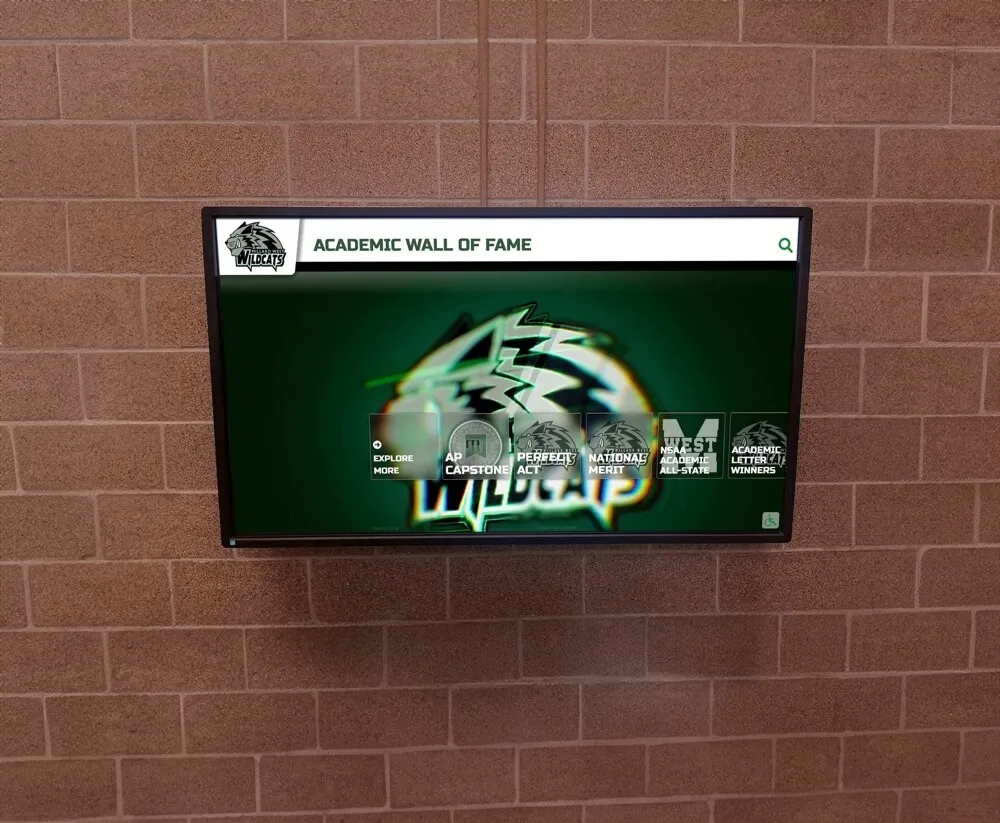
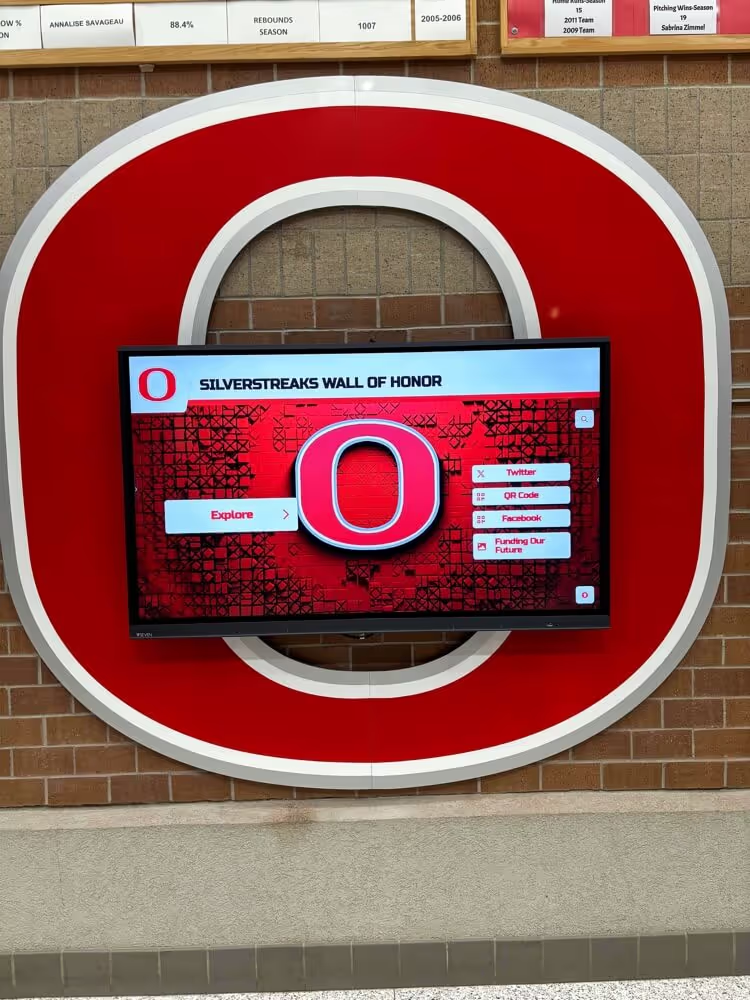
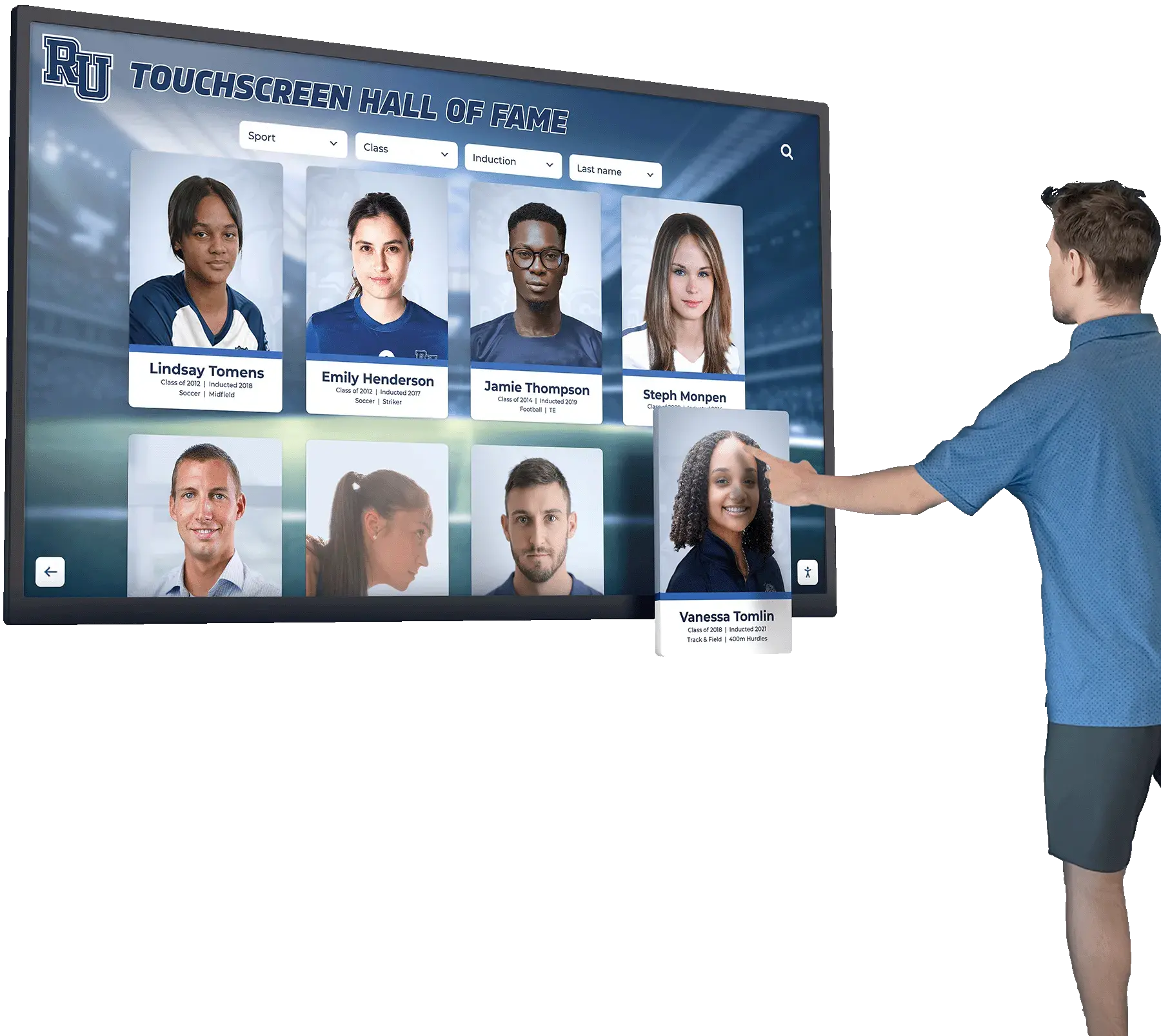
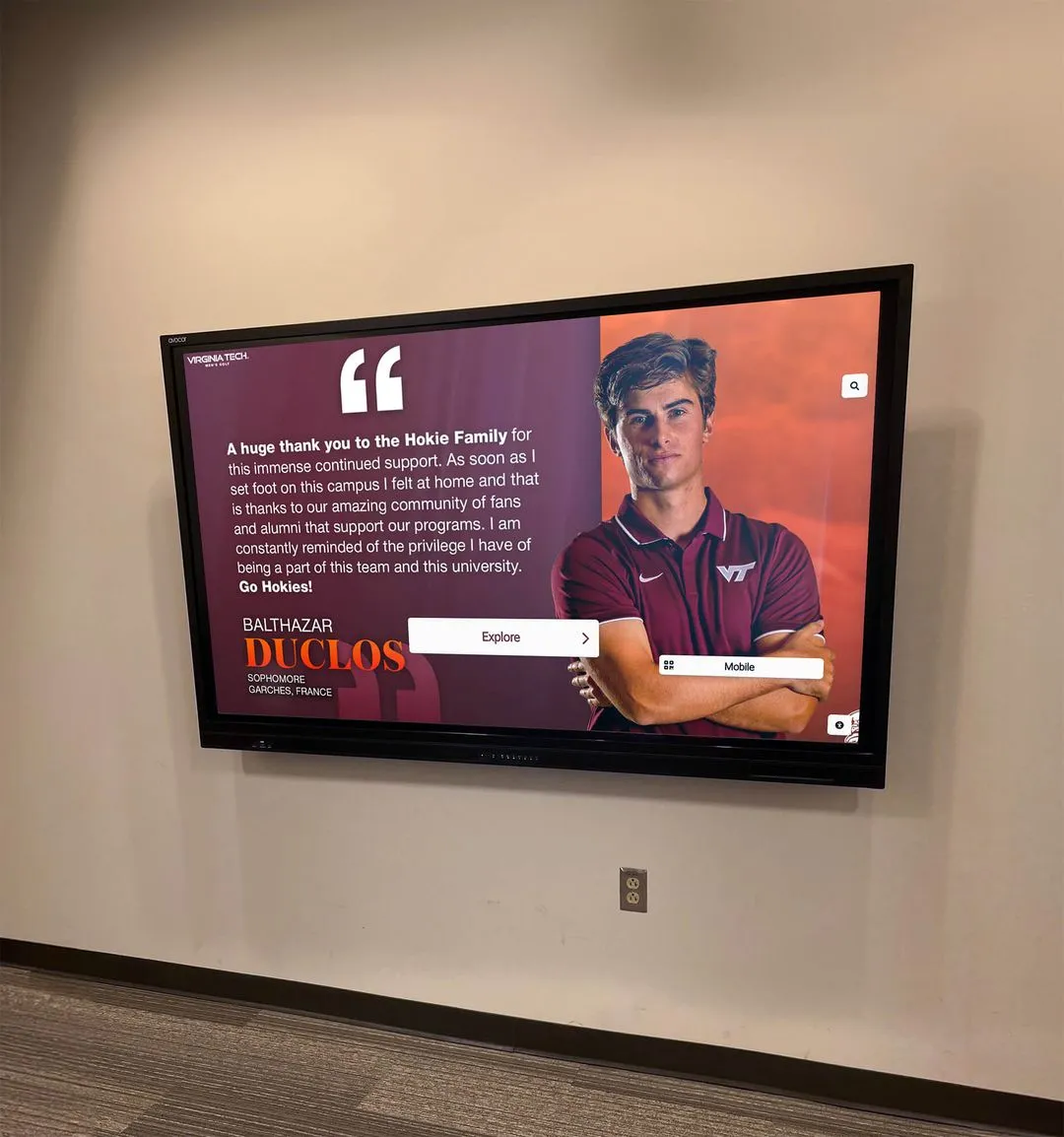
Touchscreen kiosks positioned in athletic corridors let visitors search for specific athletes, sports, and achievements that ceiling banners cannot convey
Hall of Fame Inductees
High school gym banners cannot tell you much about a hall of fame inductee. Name and sport, perhaps a graduation year. A digital hall of fame display tells you everything: career statistics, post-graduation accomplishments, photos from their playing days, quotes from coaches, connections to other inductees who played in the same era.
That depth of recognition is what makes hall of fame programs meaningful rather than ceremonial. When current students discover that a former graduate from thirty years ago still holds a school record they are chasing, the recognition creates a motivational bridge across generations. That kind of connection does not happen with a ceiling banner.
Evaluating interactive hall of fame display options is a useful starting point for athletic directors building or upgrading their hall of fame programs. Similarly, digital recognition tools for school athletics cover a range of platforms suited to different program sizes and budgets.
Donor and Booster Recognition
Athletic programs depend on booster organizations, major gift donors, and community sponsors whose financial support funds everything from travel budgets to facility upgrades. That support deserves meaningful acknowledgment—but a banner listing fifty donor names will be unreadable at gymnasium height and outdated within a year as new donors join and giving levels change.
Digital donor walls display tiered recognition clearly, update in real time when new gifts are recorded, and can include named space recognition, cumulative giving totals, and giving society membership—all without the production delays and replacement costs that make physical donor banners impractical for growing programs. Resources on donor wall and hall of fame recognition provide helpful context for programs building this infrastructure.
Academic Honor Rolls and Scholar-Athlete Recognition
Athletic facilities increasingly serve as venues for whole-school celebrations of academic achievement. Honor rolls, academic all-state lists, and scholar-athlete recognition connect athletics to the broader school culture in ways that pure athletic recognition does not. Digital displays in gymnasium lobbies and hallways are natural places for this content—it reaches the student-athlete population most directly while demonstrating that the athletic department values academic excellence alongside athletic performance.
Ideas for structuring this kind of recognition appear in resources covering sport award recognition ideas that go beyond traditional trophies and banners.
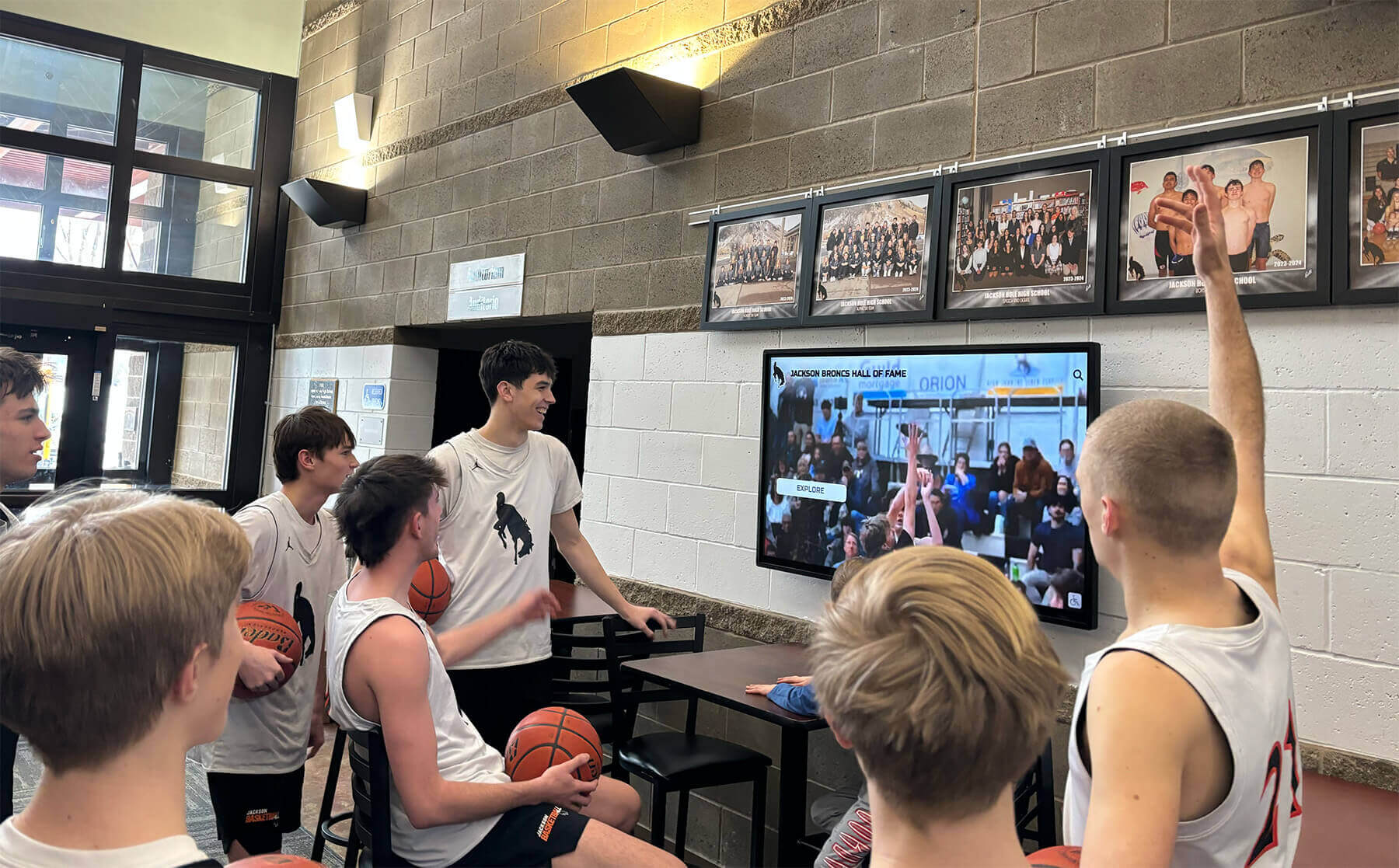
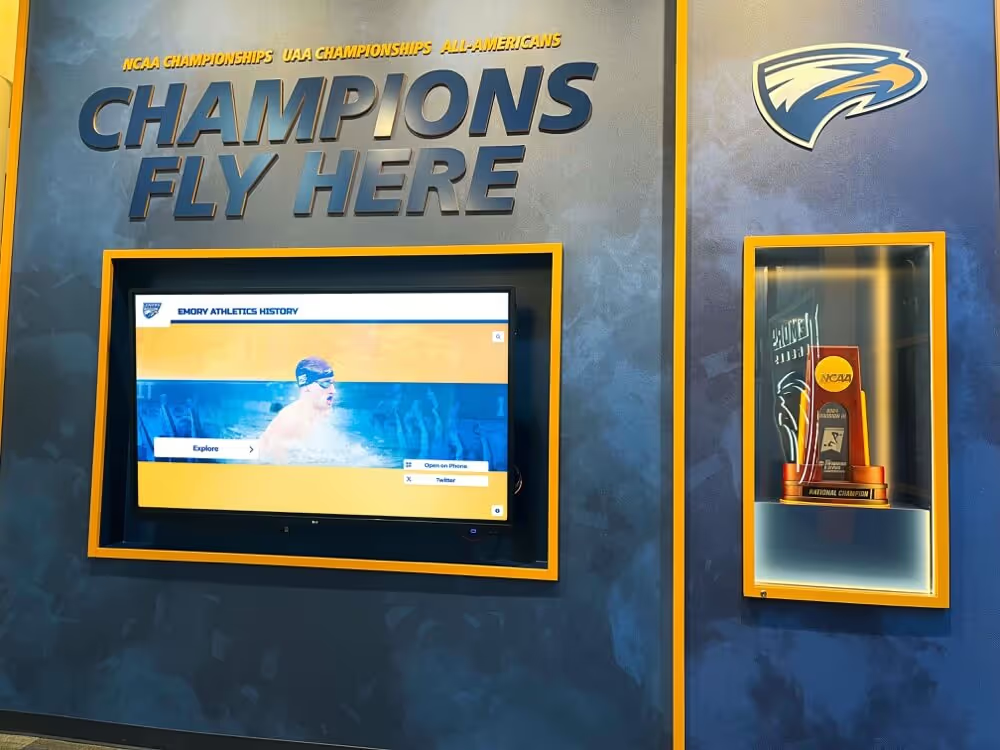
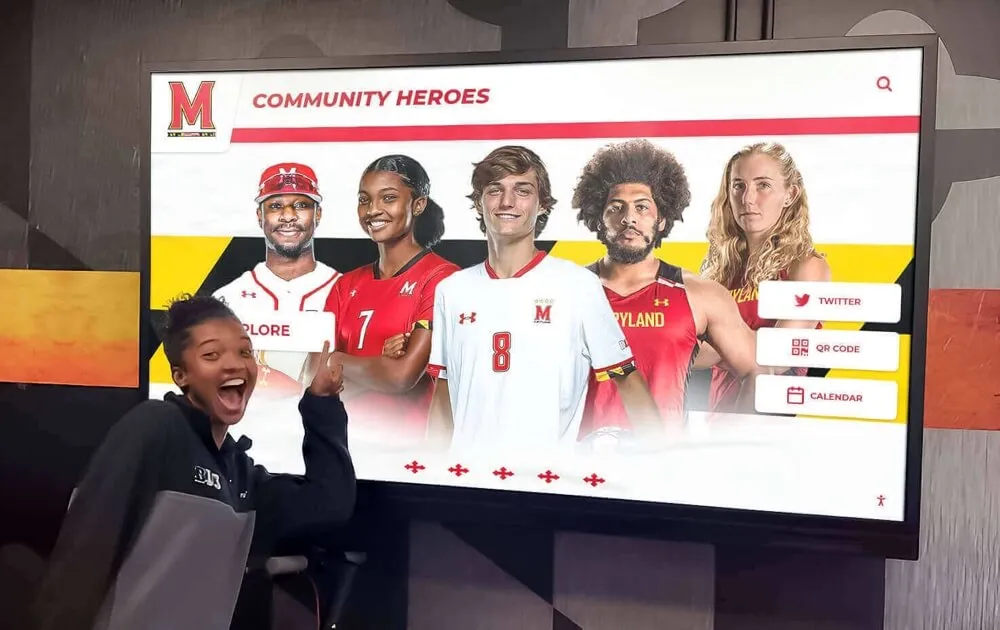
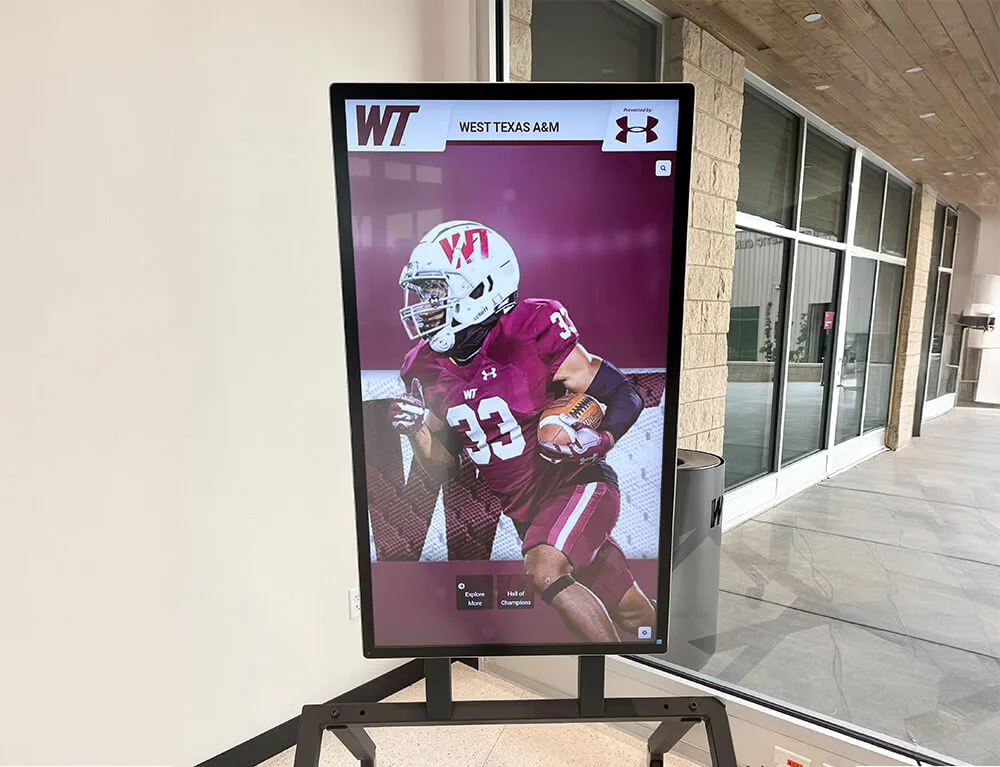
Athletic program content on digital lobby displays engages student-athletes and families in ways that ceiling-mounted banners cannot reach
Building a Hybrid Recognition System
The most effective gymnasium recognition programs combine physical banners and digital displays rather than treating them as competing alternatives. The two media have different strengths, and a thoughtfully designed hybrid system assigns each category of recognition to the format that serves it best.
Designing the Physical Layer
Start by auditing every existing banner in your gymnasium. Categorize each one using the framework above: permanent milestone, seasonal rotation candidate, or candidate for digital migration. For programs with crowded ceilings, this audit often reveals that a significant portion of existing banners fall into the second or third category—they were hung because no better option existed at the time, not because permanent ceiling placement was genuinely appropriate.
Establish a clear standard for what earns a permanent physical banner going forward. Many programs find that limiting permanent banners to state championships, retired jerseys, and identity pieces reduces annual production costs significantly while actually improving the visual clarity and weight of each piece that remains.
Positioning the Digital Layer
Digital displays work best in high-traffic locations where visitors naturally pause: gymnasium lobbies, entrance corridors, hallways connecting athletic facilities to the main building. These locations capture audiences that ceiling-mounted banners never reach—students moving between classes, families arriving before events, donors and administrators visiting the facility outside of game time.
A touchscreen display positioned near the entrance to the main gymnasium—showing hall of fame profiles, individual records, all-state selections, and current season results—supplements what hangs from the ceiling rather than replacing it. Visitors who glance up at championship banners and then step to the screen to explore the program’s history get a richer understanding of what the program has built than either medium provides alone.
Platforms like Rocket Alumni Solutions build searchable archives that accommodate unlimited content—every inductee, every record, every individual distinction—without the physical and financial constraints that govern banner programs. For schools evaluating options, understanding what different platforms offer is a useful first step. Resources covering hall of fame platform options for schools offer comparative perspectives across multiple providers.
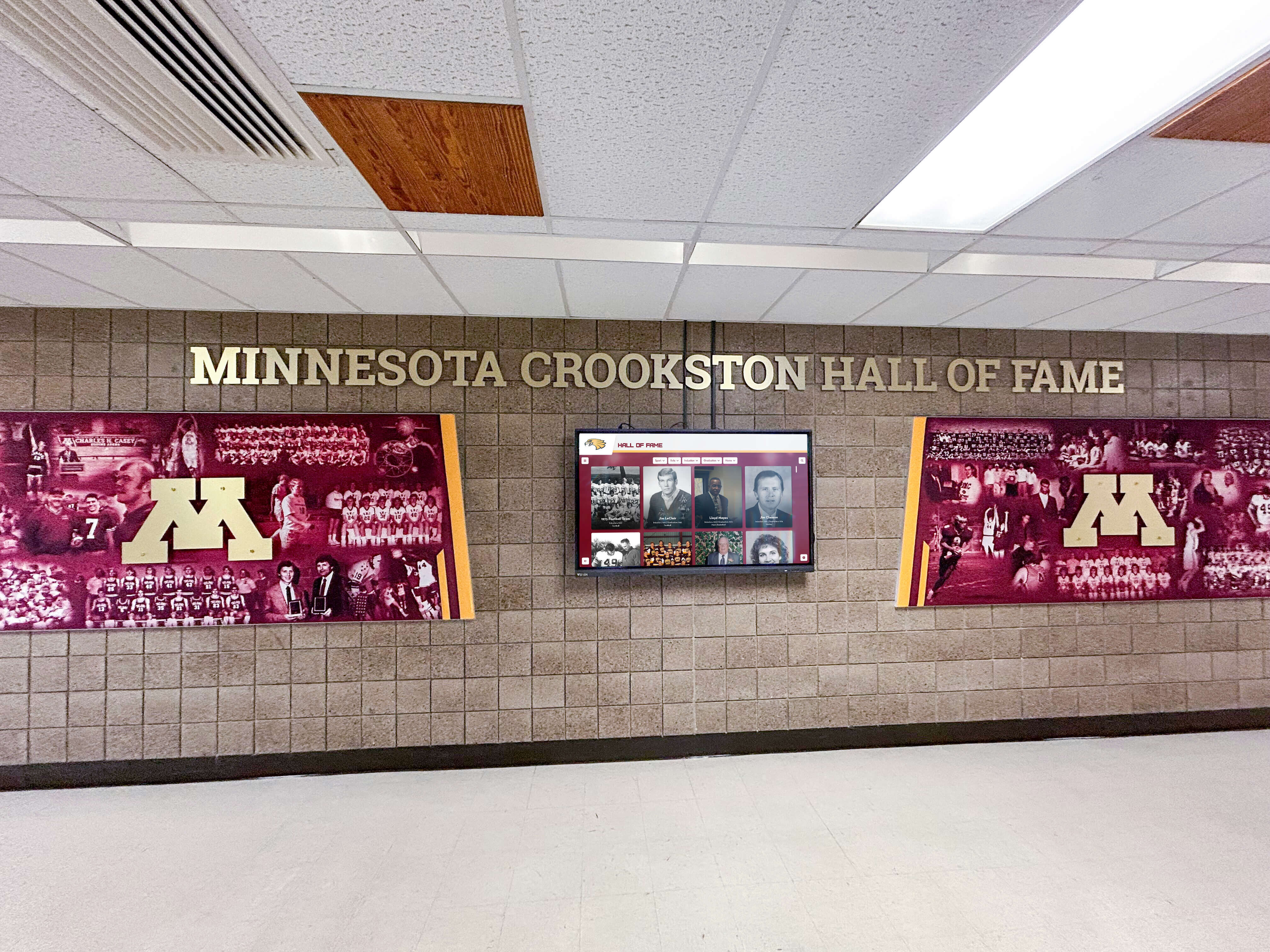
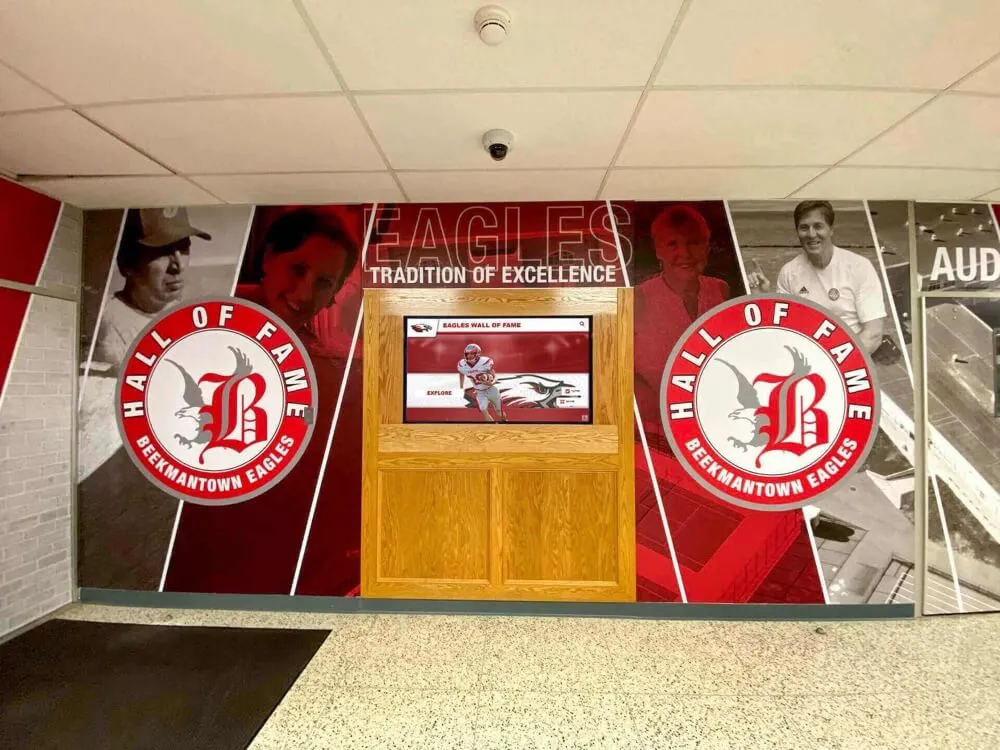
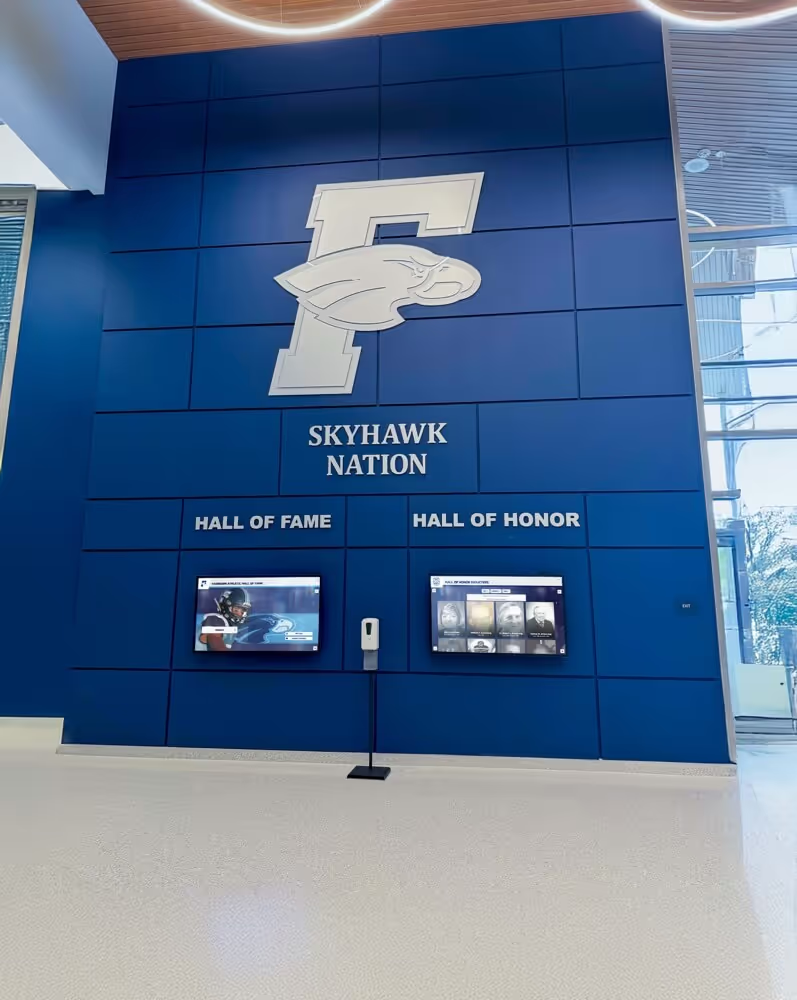
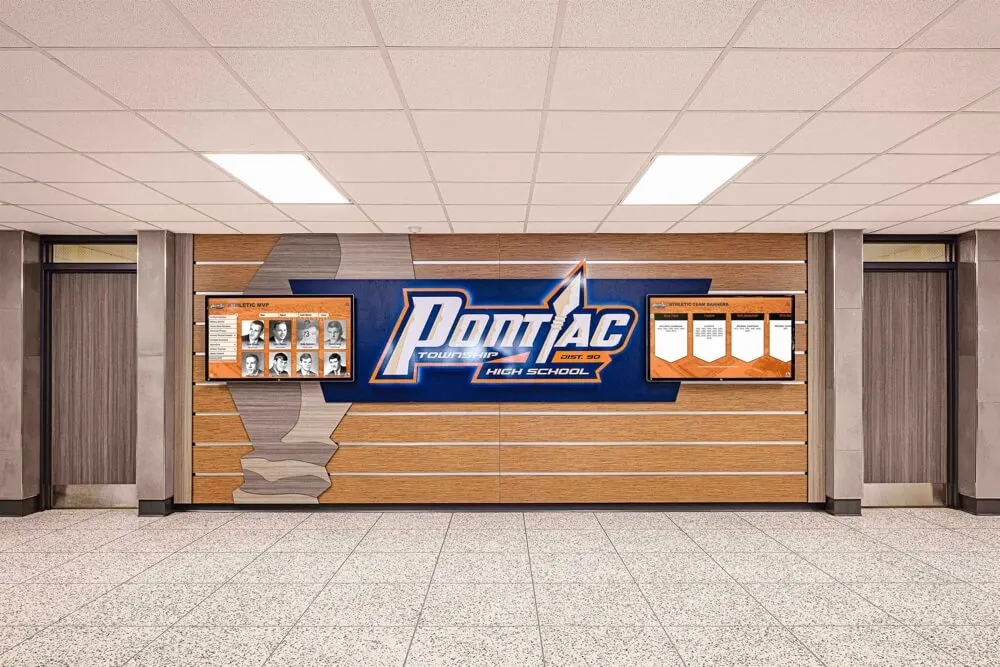
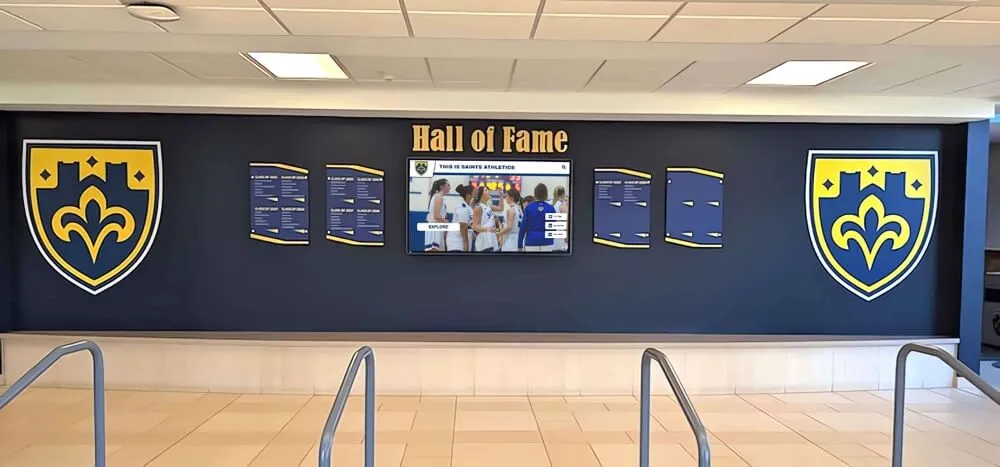
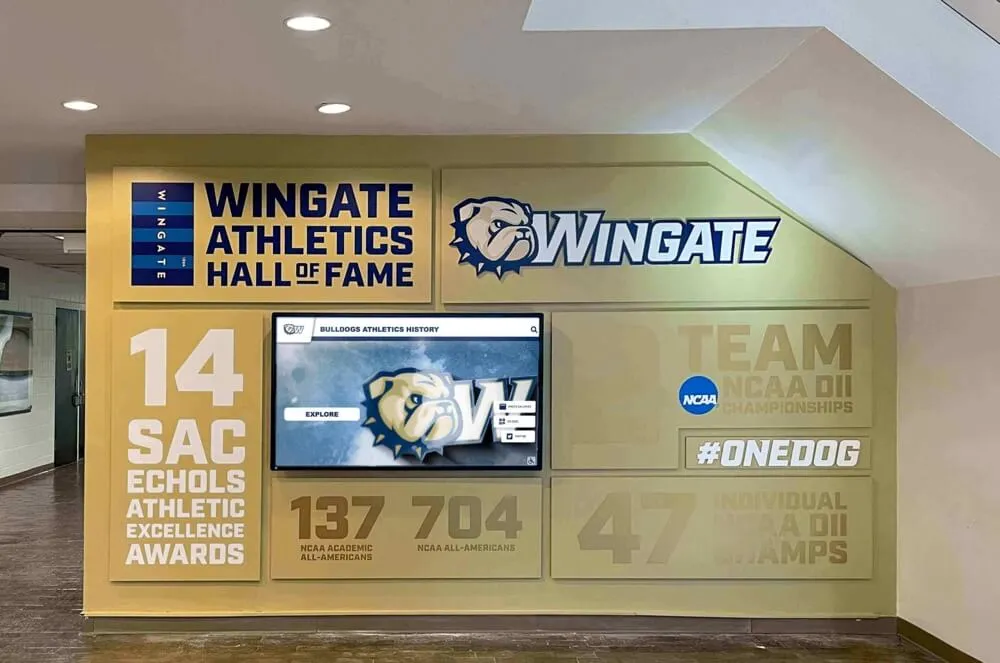
Integrated installations pair permanent architectural elements with digital screens that handle the growing, searchable content a physical wall cannot accommodate
Connecting the Two Layers
One underused strategy: QR codes on physical banners that link to richer digital content. A championship banner from 2012 with a QR code connecting to a full season archive—team photo, roster, game results, and individual awards—transforms a static ceiling display into an entry point for deeper recognition. Visitors at games can scan and explore from their phones without requiring a dedicated screen installation.
This approach is particularly effective for programs with historical banners that cannot easily be relocated but deserve more context than a fabric display conveys.
Planning for Program Growth
Athletic programs grow. Sports are added, conference affiliations change, and achieving programs accumulate more recognition than any gymnasium ceiling can hold over time. A hybrid system built on clear category rules scales naturally: new state titles earn banners, new all-state selections go into the digital archive, new hall of fame inductees get full profile pages alongside a rotating highlight on the lobby screen.
Alumni who return for reunions years after graduation find their individual recognition intact and accessible online and on-screen—an experience that high school reunion celebration traditions increasingly incorporate as digital recognition platforms become standard in school facilities.
See What a Full Recognition System Looks Like
Rocket Alumni Solutions builds searchable, unlimited digital archives for athletic programs—hall of fame profiles, record boards, all-state recognition, donor walls, and more—designed to complement your physical banner program rather than replace it.
Explore Rocket Alumni SolutionsPractical Questions Athletic Directors Ask
How do we handle banners for sports that have been discontinued?
If a sport no longer exists at your school, its championship banners occupy ceiling space that active programs cannot use for recognition. The most respectful approach is to photograph existing banners, archive them digitally in your recognition system, and then either store the physical banners or display them in lower-traffic areas like athletic offices or storage corridors. The digital archive preserves the history without claiming prime gymnasium real estate indefinitely.
What should we do with banners that are old and fading?
Before removing any fading banner, photograph it at high resolution for archival purposes. If the banner represents a permanent milestone category—a state championship or a retired jersey—commission a replacement. If it falls into the rotational or digital category, this natural retirement is an opportunity to migrate the recognition to a more appropriate medium without the awkward conversation of explicitly “removing” a banner.
How do we handle recognition equity across men’s and women’s programs?
Digital displays solve recognition equity problems that physical banners cannot. When ceiling space is finite and budgets are constrained, physical banner programs tend to favor sports with more resources and visibility. A digital system with unlimited capacity recognizes every all-state athlete in every sport, every team record in every event, with equal visual weight and equal detail. For programs navigating equity considerations, digital recognition for student athletes provides useful frameworks.
Can we use digital displays for spirit and identity content, not just recognition?
Absolutely. Digital displays positioned at gymnasium entrances work well for current-season content—schedules, game-day information, team news—that complements the permanent identity work handled by mascot banners and school color displays. The key is matching content to context: entrance displays facing arriving spectators should include wayfinding and current-event information alongside recognition, while corridor displays in athletic hallways can focus more exclusively on recognition content.
What format works best for custom gym banners that need to last?
For permanent milestone banners intended to hang for decades, double-sided polyester fabric with UV-resistant inks and reinforced grommets holds up significantly better than standard vinyl or single-layer fabric. The investment in material quality pays back over a twenty-year lifespan. For seasonal rotational banners, a lower material cost is appropriate since they will be replaced within one to three years. Ideas for framing and presenting athletic recognition—including which formats translate well at scale—appear in resources on youth athletics awards and recognition strategies.
How do we budget for a digital display installation alongside our banner program?
Entry-level digital recognition displays for athletic facilities typically range from $3,000 to $8,000 for hardware and first-year software, with ongoing annual software costs that vary by platform and feature set. Programs that offset annual banner production costs through digital migration often find that a digital system pays for itself within three to five years, depending on how many physical banners were being produced per year. Booster organizations, facility improvement grants, and named gift opportunities from donors are common funding sources for initial hardware investments.
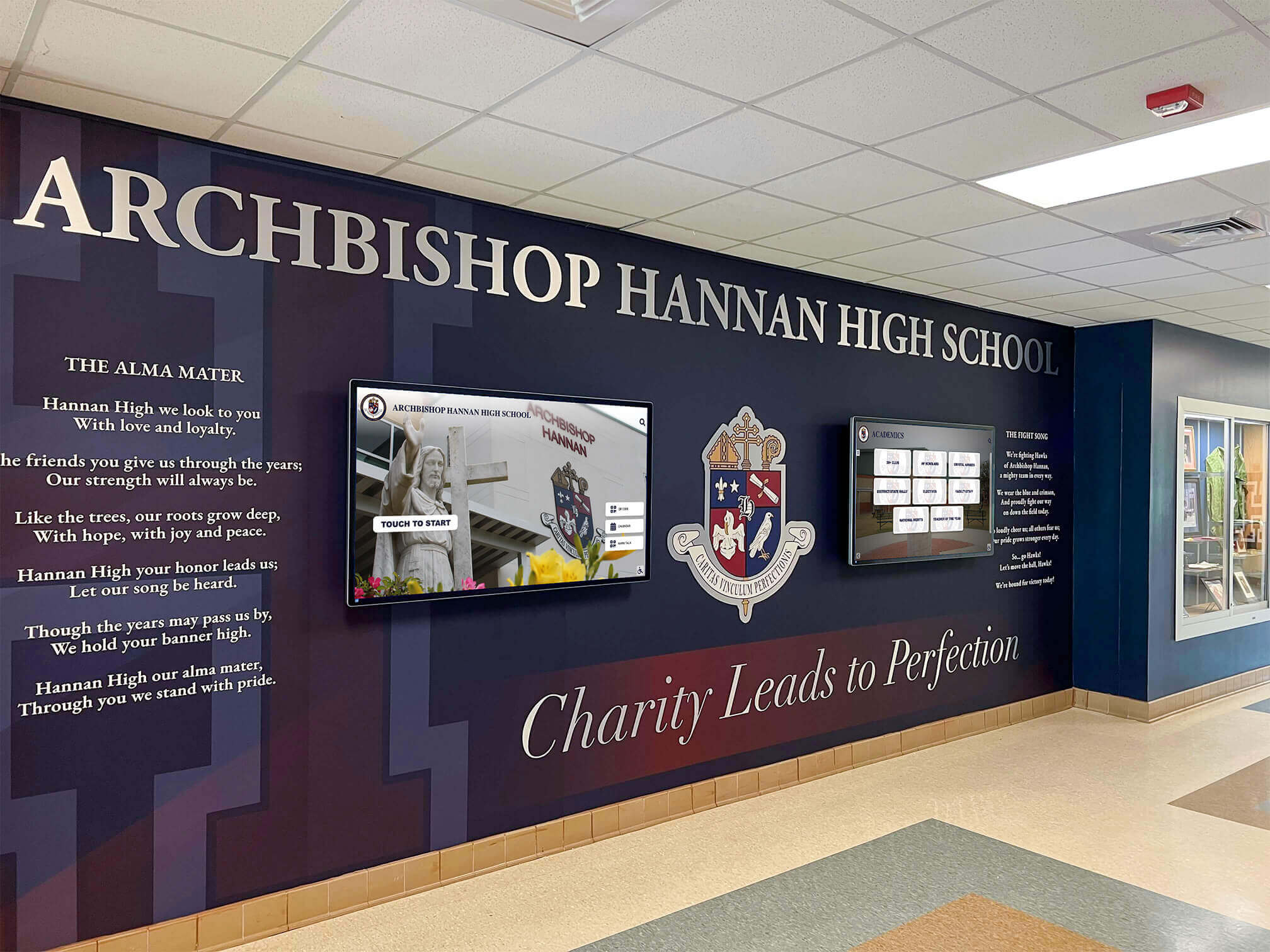
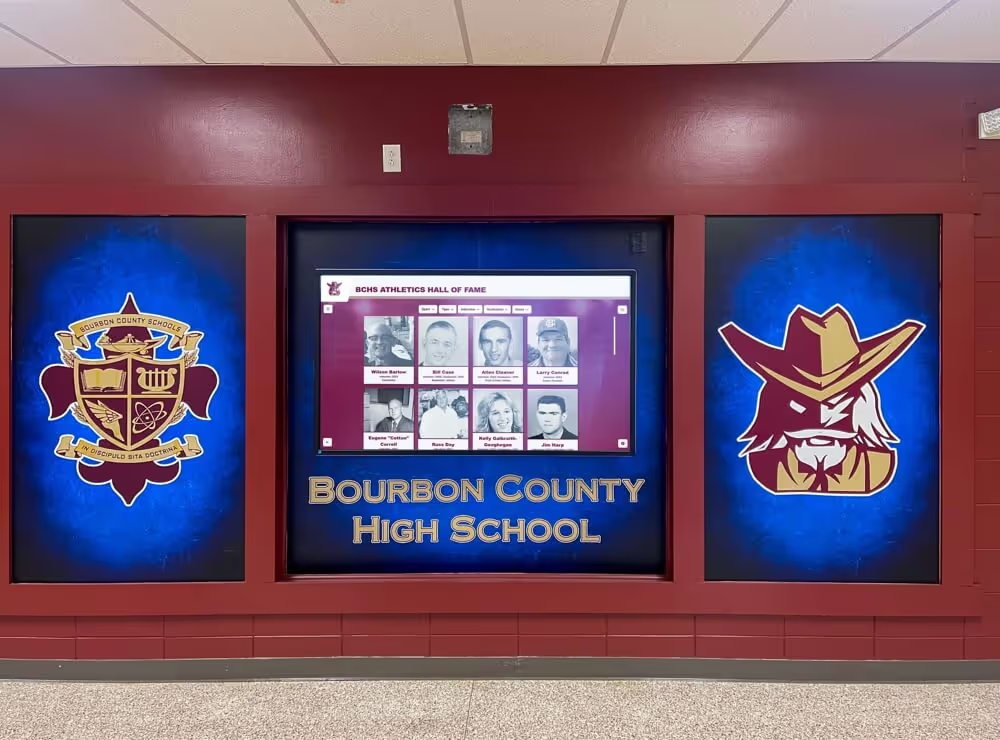
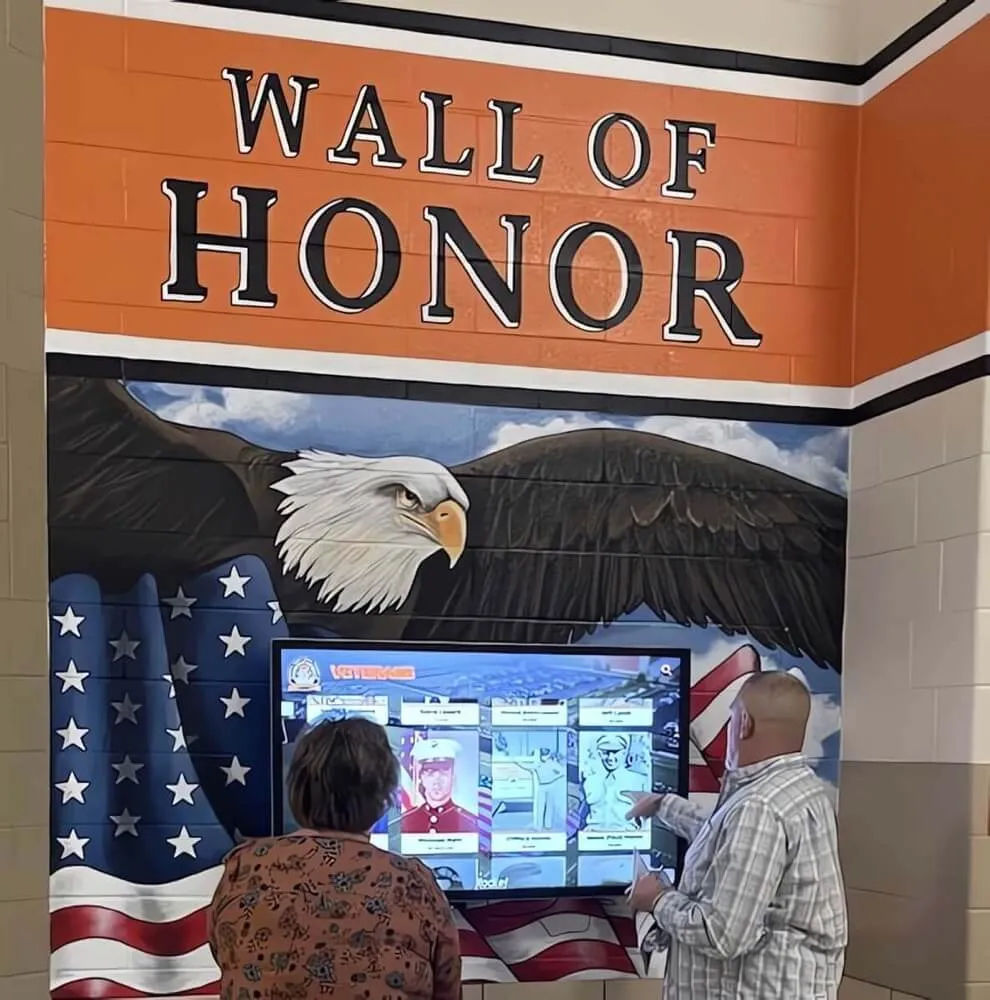
Lobby installations that combine school identity elements with digital displays create welcoming, content-rich environments that serve multiple recognition purposes simultaneously
Starting the Planning Process
Athletic directors beginning this process benefit from a structured approach that keeps stakeholders aligned before production decisions are made.
Step one: photograph and catalog every existing banner. Document what you have, including sport, year, and recognition type. This inventory is the baseline for every category decision that follows and ensures nothing is removed without a record.
Step two: apply the three-category framework. Sort your current inventory into permanent, rotational, and digital migration categories. This step often surfaces productive conversations about recognition philosophy—what a school considers a permanent milestone says something about its values and its athletic history.
Step three: identify digital migration priorities. From the third column of your planning table, determine which recognition categories would benefit most from immediate digital migration. Individual records and hall of fame archives typically deliver the most immediate value because they are the recognition categories with the greatest accumulation of unrecognized content.
Step four: establish going-forward standards. Document the criteria that will earn a permanent physical banner from this point forward, what will rotate annually, and what will be recognized digitally. Written standards prevent the ad hoc decision-making that fills ceilings with mixed-category content over time.
Step five: evaluate platform options. Platforms designed specifically for athletic recognition—rather than general digital signage—handle the specific content types that matter most: athlete profiles, record boards, searchable archives, and hall of fame formats. Comparing youth sports recognition ideas across different recognition platforms helps identify which features align with a program’s specific needs.
The planning process itself creates value independent of any purchasing decision. Athletic programs that document what recognition they have, what recognition they intend to add, and what standards will govern those decisions are better positioned to communicate with stakeholders, steward donor investments, and build recognition cultures that persist through coaching changes and administrative transitions.
School gym banners will remain a fixture of athletic facilities for the same reason school colors and mascots persist: they create identity, signal tradition, and give a physical space its character. The question is not whether to hang them but which recognition categories deserve that permanence—and which deserve something better than a spot twenty feet above the floor that no one can read from the bleachers.
Ready to Build a Recognition System That Grows With Your Program?
Rocket Alumni Solutions works with schools to create searchable digital archives for hall of fame inductees, individual records, all-state recognition, and donor acknowledgment—content that complements your physical banner program and keeps growing without filling another inch of ceiling space.
Learn About Rocket Alumni Solutions