Every fall, roughly 1.3 million high school juniors sit down for the PSAT/NMSQT. For most, it’s a practice run for the SAT. For approximately 16,000 of them, it’s the first step toward a title that will appear on every college application they submit: National Merit Semifinalist. The difference between those two groups often comes down to a handful of points on a single score called the Selection Index—and that threshold shifts depending on which state the student calls home.
This guide explains exactly how the National Merit Scholarship PSAT score system works, walks through state-by-state Selection Index cutoffs based on historical cycles, and gives school counselors a practical framework for helping students prepare, qualify, and celebrate this achievement. Whether you’re a junior calculating your odds, a parent deciphering the score report, or a counselor building recognition programs that genuinely motivate students, you’ll find the answers you need here.
The gap between a Commended Scholar and a Semifinalist can be as small as one point on the Selection Index—a margin invisible on most score reports but meaningful in the National Merit process. Understanding where your state’s cutoff typically lands, and how the scoring system works, turns that abstract number into an actionable target.

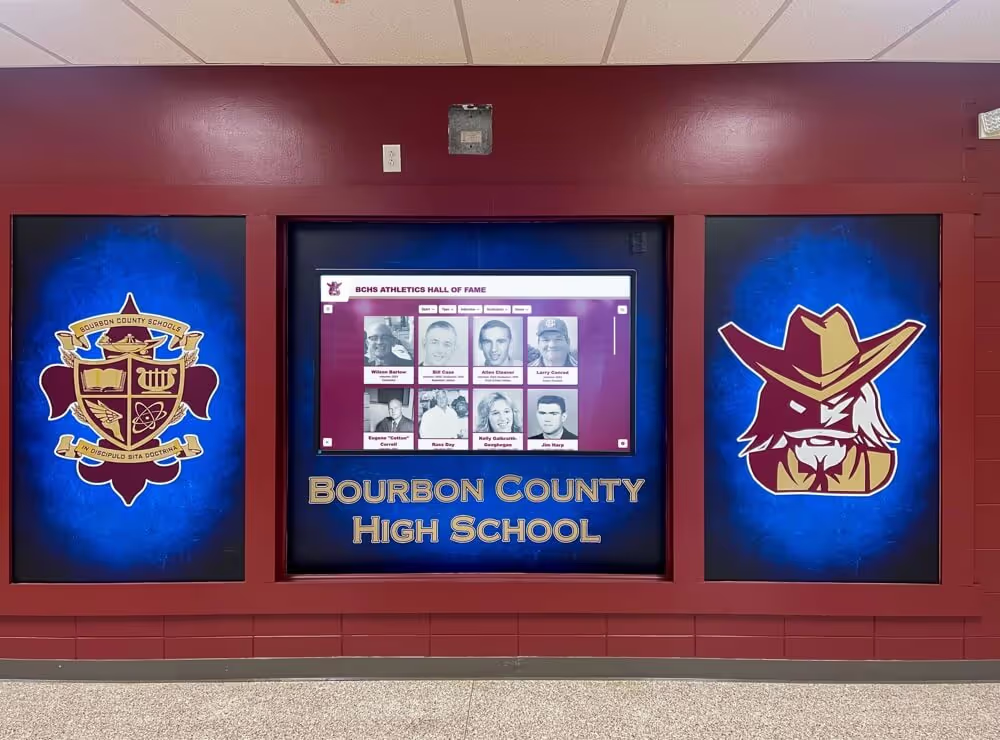
Schools that prominently display their National Merit honorees create recognition environments that motivate future high achievers to pursue the same distinction
How the National Merit PSAT Score System Works
Before diving into state cutoffs, it helps to understand precisely what score the National Merit Scholarship Corporation (NMSC) uses to evaluate students—because it’s not the composite PSAT score you see on your College Board account.
The Selection Index: What It Is and How It’s Calculated
The Selection Index (SI) is a single number ranging from 48 to 228 that NMSC uses exclusively to determine Semifinalist eligibility. It is calculated from your PSAT/NMSQT section scores as follows:
Selection Index = (Evidence-Based Reading and Writing Score ÷ 10) + (Writing and Language Score ÷ 10) + (Math Score ÷ 10) × 2
More precisely, the College Board reports PSAT section scores on a scale of 8–38 for each of three tests: Reading, Writing and Language, and Math. NMSC doubles the sum of those three test scores to arrive at the Selection Index:
SI = (Reading Test Score + Writing and Language Test Score + Math Test Score) × 2
A student scoring 37 Reading, 36 Writing, and 38 Math would calculate: (37 + 36 + 38) × 2 = 222.
This formula means Reading and Writing each contribute equally to the Math section in total weight—critical context for students deciding where to focus test preparation. Gaining two points in Reading has the same Selection Index impact as gaining two points in Math.
Why Your Composite PSAT Score Doesn’t Determine Eligibility
Many families check the PSAT composite score (which ranges 320–1520) and try to use it to estimate National Merit eligibility. This comparison is imprecise. The composite adds Evidence-Based Reading and Writing (EBRW) and Math section scores, while the Selection Index uses all three individual test scores separately. The EBRW composite obscures individual Reading and Writing performance that matters independently to the SI calculation.
The practical difference: two students with identical composite PSAT scores could have meaningfully different Selection Indexes depending on how their Reading, Writing, and Math subscores distribute.
Semifinalist, Commended, Finalist, Scholar: The Recognition Tiers
The NMSC awards recognition at four levels based on PSAT performance and subsequent application steps:
| Recognition Level | Approximate Number | How Determined |
|---|---|---|
| Commended Students | ~34,000 | High SI, below state Semifinalist cutoff |
| Semifinalists | ~16,000 | Top ~1% in each state based on SI |
| Finalists | ~15,000 | Semifinalists who complete full application |
| Merit Scholars | ~7,500 | Finalists selected for scholarship awards |
Commended recognition is meaningful—it places students in roughly the top 3–4% nationally—but only Semifinalists and above advance toward scholarship eligibility. The Commended threshold is set nationally; the Semifinalist cutoff varies by state.

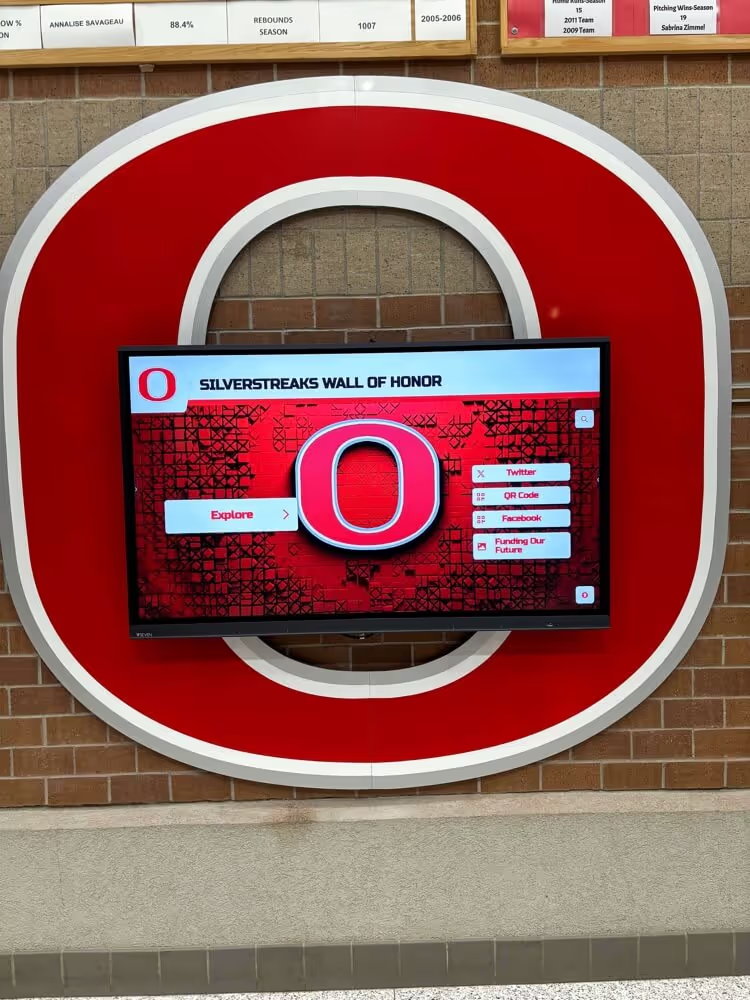
Hallway installations that integrate digital academic recognition with traditional trophy cases signal to every student that intellectual achievement matters as much as athletic success
National Merit PSAT Score Cutoffs by State
The following table lists estimated Selection Index cutoffs for Semifinalist designation by state, based on historical cycles. NMSC does not officially publish cutoff scores in advance or after notification. These figures reflect estimates widely reported by college counselors, prep companies, and educational researchers based on patterns from recent program years. Actual cutoffs shift slightly each cycle—typically by 1–3 points—depending on the difficulty of that year’s PSAT and the distribution of test-taker scores within each state.
Use these figures as planning benchmarks, not guaranteed thresholds.
State-by-State Selection Index Cutoffs (Historical Estimates)
| State | Estimated SI Cutoff | Competitiveness Tier |
|---|---|---|
| Alabama | 215 | Moderate |
| Alaska | 212 | Lower |
| Arizona | 219 | Higher |
| Arkansas | 213 | Moderate |
| California | 221 | Very High |
| Colorado | 220 | High |
| Connecticut | 220 | High |
| Delaware | 218 | High |
| District of Columbia | 222 | Very High |
| Florida | 219 | High |
| Georgia | 220 | High |
| Hawaii | 218 | High |
| Idaho | 215 | Moderate |
| Illinois | 221 | Very High |
| Indiana | 218 | High |
| Iowa | 215 | Moderate |
| Kansas | 216 | Moderate |
| Kentucky | 218 | High |
| Louisiana | 217 | Moderate |
| Maine | 217 | Moderate |
| Maryland | 223 | Very High |
| Massachusetts | 223 | Very High |
| Michigan | 219 | High |
| Minnesota | 220 | High |
| Mississippi | 211 | Lower |
| Missouri | 218 | High |
| Montana | 213 | Moderate |
| Nebraska | 215 | Moderate |
| Nevada | 217 | Moderate |
| New Hampshire | 220 | High |
| New Jersey | 223 | Very High |
| New Mexico | 214 | Moderate |
| New York | 220 | High |
| North Carolina | 220 | High |
| North Dakota | 212 | Lower |
| Ohio | 220 | High |
| Oklahoma | 216 | Moderate |
| Oregon | 219 | High |
| Pennsylvania | 220 | High |
| Rhode Island | 218 | High |
| South Carolina | 217 | Moderate |
| South Dakota | 211 | Lower |
| Tennessee | 220 | High |
| Texas | 220 | High |
| Utah | 218 | High |
| Vermont | 218 | High |
| Virginia | 221 | Very High |
| Washington | 221 | Very High |
| West Virginia | 209 | Lower |
| Wisconsin | 218 | High |
| Wyoming | 210 | Lower |
The Highest-Cutoff States
States in the “Very High” tier—Maryland, Massachusetts, New Jersey, the District of Columbia, California, Illinois, Virginia, and Washington—consistently require Selection Index scores of 220 or above for Semifinalist designation. These states tend to have large concentrations of high-scoring test-takers relative to their allocated Semifinalist slots. A student scoring a 219 SI in New Jersey would likely receive Commended recognition; that same score would make them a strong Semifinalist candidate in Montana or Arkansas.
The Lower-Cutoff States
States with lower thresholds—West Virginia, Wyoming, Mississippi, South Dakota, North Dakota, Alaska—typically have fewer PSAT test-takers overall, meaning students in the top 1% face lower absolute score requirements. NMSC’s state-by-state allocation system is specifically designed to ensure geographic diversity in the Semifinalist pool; without it, students in highly competitive coastal states would face outsized competition.
Families Who Have Recently Moved
Students who relocate between states before their junior PSAT are evaluated based on the state where they attend school, not their state of birth or former residence. A student who moves from New Jersey to Wyoming as a sophomore takes the qualifying PSAT under Wyoming’s lower threshold. The opposite is equally true: a student from Wyoming attending a New Jersey high school competes against New Jersey peers.
Why State Cutoffs Vary: The Allocation System Explained
NMSC distributes Semifinalist slots to each state approximately proportional to the state’s share of graduating high school seniors—not proportional to PSAT participation rates or average score levels. This means every state receives a roughly equal per-capita representation in the Semifinalist pool, regardless of how academically competitive the state’s test-takers are in any given year.
In practice, highly competitive states (where more students score near the top of the scale) end up with higher absolute cutoffs because their allocated slots must be distributed among a denser cluster of high scorers. Less competitive states reach their allocated slots at lower absolute SI thresholds.
This allocation philosophy has a meaningful implication for students and counselors: preparation benchmarks must be calibrated to state context, not national averages. A nationally published “target score” of 215 might be a safe Semifinalist range for a student in Montana but fall well short in Maryland.

Modern recognition systems extend beyond physical displays—mobile access lets students, alumni, and families engage with academic honor rolls from anywhere
How School Counselors Can Use Cutoff Data Effectively
State cutoff knowledge is most useful when counselors embed it in a systematic support workflow. Here’s a practical framework for turning cutoff data into student action.
Step 1: Establish a PSAT Tracking System Early
The single most valuable thing a counselor can do is normalize PSAT awareness among 9th and 10th graders—before the qualifying junior-year administration. Students who know that October of junior year is the only PSAT administration that counts toward National Merit have time to:
- Take the 10th-grade PSAT/NMSQT as a genuine diagnostic
- Identify specific section-score gaps (Reading vs. Writing vs. Math) that affect their SI
- Pursue targeted preparation through the spring and summer before junior year
- Set SI goals benchmarked to your state’s historical cutoff, not a national average
Counselors who track sophomore PSAT scores and calculate estimated Selection Indexes can identify students with strong Semifinalist potential 18 months before notifications arrive—a far more useful window than the 48 hours after scores release in January.
For students earning broader recognition alongside this preparation path, connecting them to AP Scholar award recognition programs helps frame the PSAT as one meaningful measure within a wider academic identity—not a high-stakes pass/fail test.
Step 2: Communicate the Selection Index Calculation Clearly
Most students and parents have no idea the Selection Index exists. They read a PSAT score report, see a composite number, and have no way to assess National Merit eligibility. Counselors who add a simple SI calculation step to the January score-release communication give families an immediate, actionable framework.
A one-page handout or counselor email explaining: “Take your three test scores (Reading, Writing, Math), add them together, multiply by 2. Compare that number to your state’s historical cutoff. Here’s what to do with the gap.” This is the kind of direct, practical guidance that turns information into preparation.
Step 3: Flag At-Risk Scores for Focused Remediation
Students scoring within 6–8 SI points of the state historical threshold are in the “reachable zone” where focused test prep has a realistic chance of making the difference. For students in this range who have time before their junior-year PSAT, counselors can recommend:
- Official PSAT/SAT prep resources through Khan Academy (free, adaptive)
- Section-specific strategies based on which of the three test scores is dragging the SI lowest
- Practice administrations under timed conditions to build stamina and pacing
- Small-group test strategy sessions organized through the school counseling office
Step 4: Support the Finalist Application Process
Semifinalist notification arrives in September of senior year—which coincides with Early Decision and Early Action application deadlines at many colleges. Counselors need a workflow for quickly supporting the Finalist application, which requires:
- A detailed academic record with GPA verification
- A confirming SAT score (typically 1400+ to validate PSAT performance)
- A student essay submitted through the online application
- A principal or counselor endorsement confirming accuracy
Schools that run this process efficiently can ensure that strong Semifinalists complete quality Finalist applications without sacrificing the energy they need for college applications. Building a September checklist template in advance prevents the scramble.
Counselors managing the full academic recognition calendar—from honor roll to National Honor Society digital recognition to National Merit—benefit from systematized workflows that keep each program running on its own timeline without collision.
How High-Scoring States Affect College Planning
For families in high-cutoff states like New Jersey, Maryland, or Massachusetts, the National Merit process has a specific strategic implication: college-sponsored Merit Scholarships become especially valuable, often exceeding the NMSC’s own $2,500 award.
Approximately 170 colleges and universities offer renewable scholarships specifically to National Merit Finalists who choose to enroll. Some of these awards range from $1,000 annually to full-tuition packages. The catch: these scholarships require students to designate that college as their “first choice” in the Finalist application. If the college and scholarship combination aligns with the student’s genuine interest, this can be a compelling value proposition—particularly at strong regional universities competing for top students against elite flagship institutions.
Counselors in competitive states who track National Merit carefully often maintain a list of colleges with generous Finalist-designated scholarship programs, allowing them to surface those options for students who might not otherwise consider them.
For families navigating the broader landscape of graduation honors and academic distinctions, academic rankings, and scholarship eligibility, the National Merit Scholarship program fits within a larger ecosystem of credential-building that begins with consistent high school academic performance and extends through college admissions decisions.

Digital recognition displays create natural gathering moments where community members explore and celebrate shared academic achievement traditions
Celebrating National Merit Scholars: From Announcement to Lasting Recognition
When Semifinalist notifications arrive in September, many schools respond with a morning announcement, a mention in the newsletter, and a handshake in the hallway. That’s a missed opportunity. National Merit Semifinalist designation represents a student’s placement in the top 1% of PSAT test-takers in their state. It deserves recognition at a scale that matches that significance.
Why Visible Recognition Matters
The recognition practices for top scholars and valedictorians that consistently produce the strongest results share a common thread: recognition is most motivating when it’s visible to the people who matter most to the recognized student. A name on a bulletin board reaches a few passersby. A profile on a digital display in a main hallway reaches students, staff, families, visiting alumni, and prospective families on admissions tours.
Schools that invest in visible academic recognition—particularly for high-stakes distinctions like National Merit—signal something important to their entire student body: intellectual excellence is worth celebrating here. That signal attracts more academically motivated students, retains great teachers who want to work in environments that value their students’ achievements, and creates the kind of institutional reputation that appears in the conversations families have when choosing high schools.
Alongside National Merit recognition, schools that also showcase perfect SAT score achievements and high-stakes test milestones create comprehensive academic recognition cultures rather than celebrating only a single distinction.
Digital Recognition Displays for National Merit Achievement
Physical recognition—a plaque, a trophy case, a banner—carries weight and permanence. But as the list of National Merit Scholars grows year by year, physical displays face an inherent constraint: they run out of room. A school that has produced Merit Scholars for three decades can’t fit every honoree on a hallway wall.
Digital recognition platforms solve this gracefully. Rocket Alumni Solutions builds touchscreen displays and digital walls of fame that schools use to archive complete academic achievement histories without space constraints. A counselor can add a new Semifinalist profile in minutes—complete with photo, biography, PSAT score context, college destination, and scholarship outcomes—and that profile remains permanently accessible alongside every honoree who came before.
For schools with existing honor programs, these platforms integrate naturally with academic decathlon and scholar team recognition systems, making National Merit one visible layer within a broader academic achievement landscape rather than an isolated annual announcement.
What to Include in National Merit Recognition Profiles
Effective recognition goes beyond a name and year. The most engaging profiles include:
- Full recognition tier: Commended, Semifinalist, Finalist, or Scholar designation clearly labeled
- Selection Index context: The score they achieved and how it compared to state threshold
- Academic background: Relevant coursework, AP or IB enrollment, GPA range
- Personal connection: Brief statement about academic interests or post-graduation goals
- College destination: Where the student enrolled, especially if Merit scholarship-funded
- Alumni visibility: Updated career or graduate school information as it becomes available
This depth transforms a list of names into a compelling archive of institutional achievement. When a current junior who scored a 217 SI browses the display and finds a profile of a Semifinalist who scored a 219 and now attends their dream university on a full-tuition Merit scholarship, the abstract cutoff number becomes personally meaningful.

Preserving decades of academic achievement in searchable digital archives connects current students to school traditions and inspiring alumni role models
Timing Recognition with the NMSC Calendar
Schools that build their celebration calendar around the NMSC announcement cycle capture the most impact:
September — Semifinalist notifications arrive. Immediate: school-wide announcement, social media posts, display update, photography session for new honoree profiles.
February — Finalist designations announced. Update recognition displays, communicate Finalist status to college counselors, support application completion for any remaining materials.
March–June — Scholarship awards announced. Update Scholar profiles with award details. Consider an end-of-year academic recognition assembly or display reveal that celebrates National Merit honorees alongside school awards night ceremonies that celebrate the full range of academic excellence.
Frequently Asked Questions About National Merit PSAT Scores
What is the minimum PSAT score needed for National Merit? There is no single national minimum. Eligibility is determined by your state’s Selection Index cutoff for Semifinalist designation. Based on historical estimates, state thresholds range roughly from 209 (West Virginia) to 223 (Maryland, Massachusetts, New Jersey). Students in higher-cutoff states need higher SI scores to qualify.
Is the Selection Index the same as the PSAT composite score? No. The composite score (320–1520) and the Selection Index (48–228) are calculated differently. The SI uses all three individual test scores (Reading, Writing, Math) multiplied by 2. Always check your actual SI—reported on your score report—rather than trying to infer it from your composite.
Can a student qualify as a National Merit Semifinalist by taking the PSAT as a sophomore? No. Only the October PSAT/NMSQT taken during junior year (11th grade) counts toward National Merit consideration. Sophomore and freshman administrations serve as practice only. There are limited exceptions for students with accelerated graduation timelines who request consideration through NMSC.
Do homeschooled students qualify for National Merit? Yes. Homeschooled students must arrange to take the PSAT at a local school and meet NMSC’s criteria for homeschool documentation. They compete in the state where they reside, subject to that state’s Semifinalist cutoff.
What happens if a student earns Commended Scholar recognition instead of Semifinalist? Commended recognition acknowledges performance in approximately the top 3–4% nationally. While Commended Students don’t compete for Merit Scholarships through NMSC, the credential has value in college applications and some institutions offer separate recognition or merit aid for Commended Scholars.
How much does the cutoff change year to year? Most state cutoffs shift by 1–3 points annually, depending on that year’s PSAT difficulty and score distribution. Significant multi-point swings in a single year are uncommon but not unprecedented, particularly following changes to the PSAT format. Tracking three or four years of historical estimates provides a more reliable planning range than relying on any single year.
Does taking an SAT prep course improve Selection Index performance? Targeted PSAT preparation—particularly focusing on the specific test format, timing, and question types—can meaningfully affect scores. Because the SI weights each of the three section scores equally, students who identify their weakest section and address it specifically tend to see the largest SI gains for their preparation investment.

Interactive touchscreen recognition displays invite extended exploration of academic achievements, creating warm community spaces from what would otherwise be static hallway walls
Building a School Culture Where National Merit Achievement Thrives
National Merit recognition doesn’t emerge from test preparation alone. Schools with consistent Semifinalist production over decades share structural characteristics that go well beyond coaching.
Rigorous academic programming: Consistent AP, IB, and honors enrollment builds the underlying skill base that transfers to PSAT/NMSQT performance. Students who have read analytically across multiple disciplines, practiced evidence-based writing, and engaged with advanced mathematics throughout high school arrive at October of junior year with durable skills—not just test-taking familiarity.
Early and normalized PSAT engagement: Schools where every junior takes the PSAT as a matter of course—and where counselors discuss results individually—produce more Semifinalists per capita than schools where the test is optional or treated as an afterthought.
Recognition visibility that signals values: Schools that visibly celebrate academic achievement alongside athletic success create cultures where both are genuinely valued. Students who grow up seeing National Merit honorees displayed prominently in school lobbies alongside team championship banners absorb the message that intellectual excellence is a source of institutional pride.
Counselor engagement as a through-line: The counselors who produce the most consistent National Merit outcomes aren’t waiting for high-scorers to come find them. They’re tracking sophomore PSAT results, reaching out proactively to students in the reachable zone, and running support workflows from October of junior year through May of senior year.
Final Thoughts for Families and Counselors
The National Merit Scholarship PSAT score system rewards students who combine genuine academic ability with specific awareness of how the program works. Students who know their state’s historical threshold, understand the Selection Index calculation, and target their preparation accordingly have a meaningful advantage over equally capable peers who are preparing without that context.
For counselors, the multiplier effect is significant. A single counselor who builds a systematic PSAT awareness and preparation workflow can move five to ten students per year from “strong-but-not-quite” into Semifinalist range—students who might never have realized how close they were. Over a decade, that translates into dozens of families who didn’t leave substantial scholarship money on the table.
And when those students achieve recognition, how schools celebrate that achievement matters. Names deserve profiles. Profiles deserve visibility. Visibility deserves permanence. The schools that understand this build the kinds of academic recognition environments—digital, interactive, searchable, and continuously updated—that make every Semifinalist, Finalist, and Scholar feel genuinely honored rather than briefly mentioned.
Help Your National Merit Scholars Get the Recognition They've Earned
Discover how interactive touchscreen displays let schools build permanent, searchable academic achievement archives that celebrate National Merit honorees for years to come—while inspiring the next generation to aim for the same distinction.
Explore Recognition Solutions