



Every spring, graduation ceremonies across the country celebrate students achieving magna cum laude recognition—those special graduates who earned the prestigious “with great honor” distinction through years of sustained academic excellence. Yet for many students beginning their college journey, the path to this achievement remains unclear. What GPA guarantees magna cum laude recognition? Do requirements vary between institutions? How do universities determine who qualifies for these coveted Latin honors?
Understanding magna cum laude GPA requirements matters because these distinctions represent more than ceremonial recognition. Graduating with Latin honors signals exceptional academic performance to graduate schools, scholarship committees, and employers evaluating early-career candidates. The difference between graduating with standard honors versus magna cum laude can influence graduate admissions decisions, competitive fellowship awards, and professional opportunities where academic credentials distinguish otherwise similar applicants.
This comprehensive guide demystifies magna cum laude requirements, explaining GPA thresholds across different institutions, how Latin honors systems work, strategies for achieving this recognition, and why these distinctions continue carrying significant weight long after commencement concludes.
For students targeting academic excellence, understanding the specific criteria and strategic approaches to achieving magna cum laude provides clear direction transforming abstract aspirations into concrete achievement plans. Whether you’re a high school senior planning your college approach, a current undergraduate strategizing toward graduation honors, or an educator helping students navigate academic recognition systems, this guide provides the detailed insights you need to understand and pursue this distinguished accomplishment.

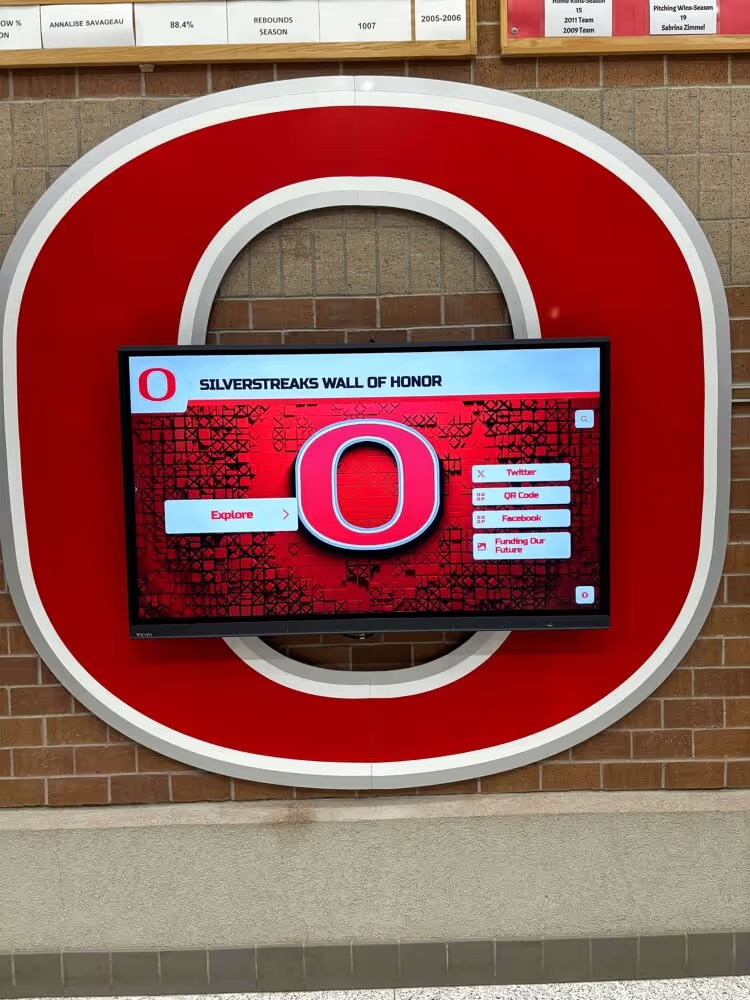
Universities increasingly celebrate academic achievements like magna cum laude through visible recognition systems that inspire excellence throughout campus communities
Understanding Latin Honors: The Three-Tier Recognition System
Before diving into specific GPA requirements, understanding how Latin honors function within broader academic recognition provides essential context for students planning their college academic strategies.
Origins and Significance of Latin Honors
Latin honors traditions emerged from European university systems, eventually becoming standard recognition mechanisms in American higher education. These distinctions—cum laude (with honor), magna cum laude (with great honor), and summa cum laude (with highest honor)—acknowledge graduating students who maintained exceptional academic performance throughout their undergraduate careers.
Historical Context and Academic Tradition
Unlike semester-based recognitions such as Dean’s List that acknowledge specific term performance, Latin honors represent cumulative achievement across an entire undergraduate experience. This comprehensive evaluation distinguishes students who sustained excellence year after year, demonstrating not only intellectual capability but also the consistency and dedication required to maintain high performance across diverse coursework, varying instructors, and competing priorities throughout college.
Universities value these distinctions because they provide standardized language recognizing achievement across institutions. When graduate program admissions committees or employers see “magna cum laude” on transcripts, they immediately understand this graduate ranked among the top performers at their institution regardless of whether they recognize the specific college or university name.
The Three-Tier Structure Explained
Most universities employing Latin honors use a three-tier system creating distinct achievement levels:
- Cum Laude (with honor): Typically the top 15-30% of graduates depending on institutional standards
- Magna Cum Laude (with great honor): Generally the top 5-15% of graduating class
- Summa Cum Laude (with highest honor): Usually reserved for top 1-5% of graduates
This tiered structure ensures recognition opportunities exist at multiple achievement levels while maintaining meaningful distinctions between good, excellent, and exceptional academic records. Students who miss summa cum laude thresholds still receive significant recognition through magna cum laude achievement, while those falling just short of magna cum laude still graduate with the respected cum laude distinction.

Modern recognition systems enable institutions to celebrate multiple tiers of academic achievement from honor roll to Latin honors distinctions
How Universities Determine Latin Honors
Institutions employ different methodologies for establishing Latin honors thresholds, with approaches generally falling into two primary categories:
Fixed GPA Threshold Systems
Many universities establish predetermined GPA requirements for each Latin honors tier. These absolute standards remain consistent year to year, providing students clear targets from freshman year forward. Common fixed thresholds include:
- Cum laude: 3.5-3.69 cumulative GPA
- Magna cum laude: 3.7-3.89 cumulative GPA
- Summa cum laude: 3.9-4.0 cumulative GPA
Fixed systems offer transparency and predictability—students know exactly what performance level guarantees specific recognition. However, these systems don’t account for grade inflation differences between majors, meaning students in traditionally harder-grading disciplines may face disadvantages compared to peers in more generous-grading programs.
Percentile-Based Ranking Systems
Other institutions determine Latin honors through class rank percentages, recognizing top performers relative to peers rather than absolute GPA thresholds. Under percentile systems, the specific GPA required for magna cum laude varies by graduating class depending on overall cohort performance.
Percentile approaches ensure consistent proportions of students receive each distinction regardless of whether a particular class proves exceptionally strong or weak academically. However, these systems create uncertainty—students can’t know precisely what GPA guarantees recognition until final class rankings are calculated, potentially after graduation applications and scholarship deadlines requiring Latin honors predictions.
Schools implementing comprehensive academic recognition programs understand that systematic celebration of achievement at all levels—from semester honors to cumulative graduation distinctions—creates cultures where intellectual excellence receives appropriate visibility and community value.
Magna Cum Laude GPA Requirements: Typical Standards Across Universities
While specific requirements vary by institution, recognizable patterns emerge across American higher education providing useful benchmarks for students planning their academic strategies.
Common GPA Thresholds for Magna Cum Laude
Most universities employing fixed GPA systems establish magna cum laude requirements between 3.7 and 3.89 cumulative GPA, though exact thresholds vary based on institutional selectivity, historical traditions, and desired recognition proportions.
Public Universities: Representative Requirements
Large public universities typically establish straightforward GPA thresholds accessible to students through registrar websites and undergraduate bulletins:
- Many flagship state universities set magna cum laude at 3.7-3.79 cumulative GPA
- Highly selective public institutions may require 3.8-3.89 for magna cum laude recognition
- Regional comprehensive universities sometimes use slightly lower thresholds around 3.6-3.75
These variations reflect different student populations, grading cultures, and institutional traditions. Students should verify their specific university’s requirements rather than assuming national averages apply to their particular situation.
Private Colleges and Universities: Institutional Variations
Private institutions demonstrate even wider variation in magna cum laude standards:
- Elite private universities may employ percentile systems rather than fixed GPAs
- Liberal arts colleges frequently use GPA thresholds between 3.7-3.85 for magna cum laude
- Some highly selective institutions set extraordinarily high bars, requiring 3.85-3.9 or higher
Additionally, certain prestigious universities use modified Latin honors systems. Harvard, for example, awards Latin honors based on academic performance within individual concentrations (majors) rather than overall GPA, acknowledging disciplinary grading differences while maintaining rigorous standards.

Prominent hallway displays ensure academic honors including magna cum laude achievements inspire daily motivation throughout student communities
Percentile-Based Requirements and Class Rank
For universities using relative ranking rather than absolute GPA thresholds, magna cum laude typically recognizes students ranking in approximately the top 5-15% of their graduating class.
Understanding Percentile Calculations
Under percentile systems, exact GPA requirements fluctuate based on cohort performance. An exceptionally strong graduating class might require 3.85 GPA for top 10% placement and magna cum laude qualification, while a weaker cohort could see students with 3.75 GPAs achieving the same percentile rank and recognition.
This variability creates challenges for students seeking concrete targets during their undergraduate years. However, tracking historical data from recent graduating classes provides reasonable estimates helping students gauge whether current performance trajectories position them competitively for honors recognition.
Combined Systems: Minimum GPA Plus Percentile Requirements
Some institutions employ hybrid approaches requiring both minimum GPA thresholds and top percentile rankings. For example, a university might stipulate magna cum laude requires 3.6 minimum GPA AND top 15% class ranking. This combined approach prevents recognition of students with strong GPAs in weak graduating cohorts while ensuring absolute performance standards remain meaningful.
Special Considerations and Modified Requirements
Beyond basic GPA calculations, universities often implement additional criteria or modifications affecting Latin honors determination:
Transfer Credit and Residence Requirements
Most institutions exclude transfer credits from Latin honors GPA calculations, evaluating only coursework completed at the degree-granting university. Additionally, schools typically require minimum credit hours completed in residence—often 60+ semester hours—ensuring sufficient performance data exists for meaningful honors assessment.
Transfer students should understand these policies early, recognizing that strong performance at previous institutions doesn’t contribute to Latin honors qualification at their degree-granting university. However, some transfer-friendly institutions develop modified systems acknowledging transfer student circumstances while maintaining rigorous standards.
Major-Specific and Departmental Honors
Certain universities offer departmental or major-specific honors separate from or in addition to university-wide Latin honors. These specialized distinctions evaluate students within their concentration, acknowledging that grading rigor varies significantly between disciplines.
Engineering students might earn departmental honors through different criteria than English majors, reflecting field-specific expectations while ensuring recognition remains attainable across different academic areas. Students pursuing these specialized honors should consult department guidelines understanding requirements, application processes, and recognition timelines distinct from general university honors systems.
Universities implementing recognition displays for academic achievements ensure that multiple levels of distinction—from departmental honors to university-wide Latin recognition—receive appropriate celebration inspiring achievement throughout student populations.
Strategies to Achieve Magna Cum Laude Recognition
Understanding requirements represents only the first step—achieving magna cum laude demands strategic planning, consistent execution, and proactive approaches maximizing academic performance throughout college.
Strategic Course Planning and Major Selection
Thoughtful academic planning dramatically influences cumulative GPA outcomes and honors qualification probability.
Understanding Grading Cultures Across Disciplines
Different academic departments maintain distinct grading philosophies and standards. STEM fields, particularly engineering and physical sciences, traditionally employ more stringent grading than humanities and social sciences. Students in notoriously difficult majors face inherent disadvantages under Latin honors systems based solely on cumulative GPA without major-specific adjustments.
This reality shouldn’t discourage students from pursuing challenging fields, but awareness enables strategic planning. Students committed to difficult majors might compensate through careful general education selections, ensuring distribution requirements provide opportunities for strong performance balancing more demanding major coursework.
Balancing Challenge with Performance
While intellectual curiosity should drive course selection, students targeting specific GPA thresholds must balance academic challenge with realistic performance expectations. Taking exclusively difficult courses demonstrates admirable ambition but risks undermining cumulative GPA if performance suffers from overwhelming difficulty or excessive workload.
Strategic students identify when their schedules can accommodate particularly challenging courses—semesters with lighter overall credit loads, fewer extracurricular commitments, or subject matter building on prior knowledge enabling more efficient learning. This thoughtful distribution helps maintain strong performance across all coursework rather than sacrificing overall GPA for isolated ambitious undertakings.

Accessible recognition technology enables students to explore achievement histories discovering peer role models and understanding paths to academic excellence
General Education and Elective Optimization
Distribution requirements and elective opportunities provide strategic spaces for GPA management. Students should research general education courses known for reasonable grading while offering genuine educational value, avoiding the trap of seeking “easy A” courses providing minimal learning.
Professor selection matters tremendously—instructors teaching identical courses often maintain dramatically different grading standards and teaching effectiveness. Leveraging peer recommendations, rate-my-professor resources, and academic advisor guidance identifying sections taught by excellent instructors known for fair assessment and clear expectations improves learning quality while supporting strong performance.
Consistent Performance and Academic Discipline
Magna cum laude recognition requires sustained excellence across four years, making consistent habits more valuable than sporadic exceptional performance.
Establishing Effective Study Routines Early
Students who develop strong study systems during freshman year position themselves for long-term success. Consistent routines—designated study spaces, regular homework schedules, systematic note-taking methods, and proactive assignment management—create foundations supporting strong performance throughout college.
The cumulative nature of Latin honors means early-year performance carries equal weight with junior and senior grades. Students who struggle freshman year face uphill battles recovering cumulative GPA even with exceptional later performance, while those establishing strong patterns immediately build momentum carrying through graduation.
Proactive Use of Academic Support Resources
Successful students utilize available assistance preventatively rather than reactively. Writing centers, quantitative support labs, subject tutoring, and professor office hours exist precisely to support high achievement—using these resources demonstrates strategic intelligence rather than academic weakness.
Regular office hour attendance builds faculty relationships providing advantages beyond immediate course assistance. Professors remember engaged students, often offering flexibility during genuine emergencies, nominating students for competitive opportunities, and providing enthusiastic recommendation letters supporting graduate school and scholarship applications where Latin honors designations prove particularly valuable.
Time Management and Priority Balance
Achieving magna cum laude while maintaining holistic college experience requires sophisticated time management balancing academics with extracurricular engagement, social development, and personal wellness. Students treating academics as non-negotiable first priority while strategically limiting overcommitment to activities create sustainable approaches preventing burnout while maintaining performance standards.
This balanced approach recognizes that graduate schools and employers value well-rounded candidates—magna cum laude graduates who also demonstrated leadership, community service, or professional experience through thoughtful extracurricular participation stand out more than academically-focused students lacking broader engagement despite marginally higher GPAs.
Recovery Strategies and GPA Repair
Students who experience academic setbacks need not abandon Latin honors aspirations—strategic recovery remains possible depending on timing and performance deficits.
Mathematical Realities of Cumulative GPA Recovery
Understanding GPA mathematics helps students assess recovery feasibility. Cumulative GPA becomes increasingly difficult to change as more credits accumulate—a poor freshman semester can be overcome through subsequent strong performance, but junior year difficulties prove harder to repair with limited remaining coursework.
Online GPA calculators enable students to model scenarios understanding exactly what grades in remaining courses would achieve target cumulative GPAs. This analysis provides realistic assessment helping students determine whether magna cum laude remains attainable or whether adjusting goals toward cum laude or graduation without Latin honors proves more appropriate.
Strategic Use of Summer Sessions and Additional Coursework
Students falling slightly short of target GPAs might consider strategic summer course enrollment or increased credit loads during regular semesters. Additional courses provide extra opportunities for strong grades improving cumulative averages, though this approach requires careful consideration of workload manageability.
Quality matters more than quantity—taking extra courses that compromise performance across entire schedules proves counterproductive. However, thoughtfully selected additional coursework during semesters when time permits can meaningfully impact cumulative GPA while accelerating progress toward degree completion.

Prominent lobby installations featuring academic honor recognition create visible celebration of excellence while inspiring campus-wide intellectual engagement
Beyond GPA: Additional Criteria for Latin Honors
While cumulative GPA represents the primary determination factor, many universities implement supplementary requirements ensuring Latin honors recipients demonstrate comprehensive academic excellence.
Good Academic Standing and Conduct Requirements
Most institutions require students to remain in good academic and disciplinary standing throughout undergraduate careers to qualify for graduation honors regardless of GPA achievement.
Academic Integrity and Honor Code Compliance
Universities universally exclude students with academic integrity violations from Latin honors eligibility. Documented cheating, plagiarism, or other academic dishonesty typically results in permanent disqualification from honors consideration even when cumulative GPA otherwise exceeds required thresholds.
This strict stance reflects the principle that honor-based recognition requires genuine achievement through ethical means. Students pursuing Latin honors must maintain absolute academic integrity, understanding that momentary lapses potentially eliminate years of achievement from honors recognition.
Disciplinary Standing Requirements
Beyond academic integrity specifically, some institutions require clean disciplinary records for honors eligibility. Significant conduct violations—particularly those resulting in suspension or major sanctions—may disqualify otherwise academically qualified students from Latin honors recognition.
These policies vary considerably between universities, with some maintaining strict zero-tolerance approaches while others evaluate violations contextually. Students should understand specific institutional policies recognizing that campus conduct carries implications beyond immediate sanctions potentially affecting graduation recognition.
Credit Hour and Coursework Requirements
Universities typically establish minimum credit requirements ensuring sufficient performance data exists for meaningful honors evaluation.
Minimum Credits in Residence
As noted previously, most institutions require substantial coursework completion at the degree-granting university—commonly 60 semester hours or approximately half the credits required for graduation. This residency requirement prevents students from completing majority coursework elsewhere before transferring for degree completion while claiming honors based primarily on external work.
Transfer students should verify specific residency requirements early, understanding these policies affect honors eligibility and planning coursework distribution accordingly. Some transfer-friendly institutions implement modified requirements acknowledging transfer student realities while maintaining meaningful standards.
Specific Coursework Completion
Certain universities require honors candidates to complete particular courses or curriculum elements beyond standard degree requirements. Honors thesis or capstone projects, minimum upper-division credits, or specific numbers of courses within major concentration might constitute additional criteria for Latin honors qualification.
These requirements ensure honored graduates demonstrate achievement not just through grades but through engagement with challenging advanced coursework requiring independent research, creative work, or comprehensive integration of knowledge across their field of study.
Schools implementing recognition systems for multiple achievement types understand that celebrating diverse accomplishments—from semester honors to specialized academic recognitions to cumulative Latin honors—creates comprehensive cultures valuing intellectual excellence across multiple dimensions.
Why Magna Cum Laude Recognition Matters: Long-Term Benefits
Understanding the lasting value of Latin honors helps students appreciate why sustained effort toward this achievement provides returns extending far beyond commencement ceremonies.
Graduate School and Professional Education Advantages
Magna cum laude recognition carries particular weight in competitive graduate program admissions where academic credentials significantly influence selection decisions.
Graduate Admissions Committee Perspectives
Law schools, medical schools, doctoral programs, and competitive master’s degrees receive applications from candidates with strong undergraduate records. Within pools of academically qualified applicants, distinctions like magna cum laude help admissions committees differentiate between merely good students and exceptional achievers demonstrating sustained excellence.
Latin honors provide objective, institution-validated evidence of superior performance versus self-reported GPA information or subjective recommendation letter claims. Graduate programs recognize that achieving magna cum laude required maintaining high standards across diverse coursework over four years—exactly the sustained excellence predicting graduate school success through similarly demanding multiyear programs.
Scholarship and Fellowship Applications
Prestigious scholarships—Rhodes, Marshall, Fulbright, and numerous field-specific fellowships—attract applications from outstanding candidates. Review committees evaluating hundreds of strong applications use academic distinctions including Latin honors as preliminary screening criteria and differentiating factors between otherwise comparable candidates.
Many competitive awards explicitly reference academic honors in eligibility requirements or evaluation criteria. Magna cum laude recognition can mean the difference between preliminary screening advancement and early elimination from consideration in processes where hundreds of qualified candidates pursue limited awards.

Integrated recognition systems combine digital displays with traditional elements creating impressive environments celebrating academic excellence and Latin honors achievements
Professional Career Advantages and Resume Credibility
While academic honors matter less in established careers, they provide significant advantages for recent graduates entering competitive job markets with limited professional experience.
Resume Enhancement for Early-Career Professionals
New graduates often lack extensive work histories distinguishing them from peers with similar educational credentials. Magna cum laude recognition provides concrete evidence of work ethic, discipline, attention to detail, and performance consistency—exactly the qualities employers seek but struggle to evaluate in candidates without substantial professional track records.
Recruiters reviewing stacks of entry-level applications use academic distinctions as shorthand for identifying high-potential candidates. Two otherwise similar resumes—one showing 3.8 GPA magna cum laude graduation, another listing 3.5 GPA without honors—create different impressions even when both candidates likely possess strong capabilities. The Latin honors designation signals exceptional rather than merely competent performance.
Credibility in Competitive Industries
Certain industries particularly value academic credentials for entry-level hiring. Consulting firms, investment banking, research organizations, and academic institutions traditionally recruit heavily from top-performing graduates. Magna cum laude recognition provides validation that candidates succeeded within rigorous academic environments under pressure—experiences translating directly to demanding professional contexts.
Even as careers progress, Latin honors listed on LinkedIn profiles and professional biographies provide lasting credibility. Years or decades after graduation, these distinctions continue signaling that individuals demonstrated exceptional performance in challenging evaluative environments, contributing to overall impressions of competence and achievement across careers.
Alumni Recognition and Institutional Connection
Universities implementing digital recognition systems for distinguished graduates create ongoing visibility for academic achievements including Latin honors that strengthen alumni connections with institutions. These recognition systems enable honored graduates to remain connected with alma maters while inspiring current students through visible examples of achievable excellence.
Personal Pride and Achievement Validation
Beyond external benefits, magna cum laude recognition provides intrinsic satisfaction validating years of sustained effort and intellectual engagement.
Ceremonial Recognition and Family Pride
Graduation ceremonies distinguish Latin honors recipients through special regalia, separate recognition during commencement, or exclusive honors convocations preceding general graduation exercises. These ceremonial acknowledgments create memorable experiences celebrating accomplishment while enabling families to witness formal recognition of years supporting student academic success.
Special cords, stoles, or medallions worn during commencement visibly identify honors graduates, providing tangible symbols of achievement students preserve long after ceremonies conclude. Family members often express particular pride seeing their students honored publicly, creating meaningful culminating moments to undergraduate experiences.
Transcript Documentation and Permanent Record
Latin honors appear permanently on official transcripts providing lasting documentation of undergraduate achievement. This permanent notation ensures recognition remains verifiable throughout careers regardless of how long ago graduation occurred or how circumstances change over time.
Unlike semester-based recognitions that may not transfer or persist, Latin honors designations remain part of permanent academic records—evidence available whenever academic credentials require verification for professional licenses, career advancement, or new educational pursuits.
How Universities Celebrate Magna Cum Laude and Latin Honors
Understanding recognition mechanisms helps students appreciate the various ways institutions acknowledge Latin honors achievement beyond simple transcript notation.
Traditional Commencement Recognition Methods
Most universities employ standard ceremonies and symbols distinguishing honors graduates during commencement exercises.
Regalia and Visual Distinctions
Specific honor cords, stoles, medallions, or modified tassels identify Latin honors recipients during graduation ceremonies. Color schemes vary by institution—some universities use gold cords for all Latin honors graduates, others employ different colors distinguishing between cum laude, magna cum laude, and summa cum laude tiers.
These visible markers create public recognition during commencement ceremonies enabling families, friends, and fellow graduates to identify honored students. The ceremonial regalia provides tangible symbols students preserve as lasting mementos of undergraduate achievement.

Intuitive touchscreen interfaces enable exploration of comprehensive achievement records including academic honors, creating engaging experiences that inspire excellence
Special Recognition During Ceremonies
Many commencement programs include specific acknowledgment of Latin honors graduates. Ceremonies might request honors recipients to stand for applause, announce names of highest honors achievers, or conduct separate processionals distinguishing honored graduates from general graduating class.
These ceremonial elements ensure Latin honors achievement receives appropriate public recognition during milestone events celebrating academic completion, emphasizing institutional values prioritizing intellectual excellence and sustained achievement.
Modern Digital Recognition Approaches
Forward-thinking institutions implement comprehensive recognition systems ensuring Latin honors achievement receives ongoing visibility beyond one-day ceremonies.
Interactive Campus Recognition Displays
Digital platforms enable universities to showcase honors graduates through engaging touchscreen installations in prominent campus locations. These systems create year-round visibility for academic achievement including:
- Searchable databases of recent graduates including Latin honors designations
- Historical archives of distinguished alumni with undergraduate honors recognition
- Statistical summaries celebrating collective achievement across graduating classes
- Individual graduate profiles featuring photos, majors, and achievement details
- Integration with other recognition categories creating comprehensive documentation
These digital recognition displays provide sustained inspiration rather than momentary ceremony acknowledgment, building campus cultures where intellectual achievement receives visibility comparable to athletic success while inspiring underclassmen toward similar excellence.
Web-Based Recognition Extensions
Online recognition portals enable global access to graduation honors celebrations. Web platforms allow:
- Families anywhere to discover and share student achievements
- Alumni to reconnect with institutional traditions and locate fellow honored graduates
- Prospective students to research academic culture and achievement standards
- Employers and graduate programs to verify honors designations
- Current students to explore recent graduates as achievement role models
Mobile-optimized systems ensure recognition remains accessible across devices while providing sharing capabilities enabling graduates to distribute achievements through professional and social networks amplifying acknowledgment beyond campus boundaries.
Solutions like Rocket Alumni Solutions enable universities to create comprehensive recognition ecosystems celebrating achievements from semester honors through graduation distinctions, building “digital warming” effects that transform cold achievement lists into engaging community experiences inspiring broader student populations toward academic excellence.
Honors Convocations and Special Ceremonies
Many universities host separate honors convocations preceding general commencement exercises. These intimate ceremonies enable:
- Extended recognition of individual Latin honors graduates
- Faculty addresses specifically focused on intellectual achievement and academic values
- Small-group atmosphere facilitating meaningful acknowledgment
- Special guest speakers and distinguished alumnus presentations
- Enhanced family experience celebrating academic distinction
These dedicated events signal institutional commitment to celebrating intellectual excellence while providing more personal recognition than massive general graduation ceremonies permit.
Comparing Latin Honors Across Different Types of Institutions
Understanding how magna cum laude requirements and recognition vary across institutional types helps students assess relative achievement levels and set appropriate expectations.
Research Universities vs. Liberal Arts Colleges
Different institutional models employ distinct approaches to Latin honors reflecting varied educational philosophies and student populations.
Large Research Universities
Major research institutions typically serve diverse student populations across numerous majors with varying grading standards. These universities commonly employ fixed GPA thresholds providing transparency and consistency across large, heterogeneous graduating classes:
- More likely to use absolute GPA cutoffs rather than percentile rankings
- May implement department-specific modifications acknowledging grading differences
- Often recognize larger absolute numbers of honors graduates given substantial class sizes
- Might offer both university-wide and college-specific honors within multi-college structures
The scale of these institutions necessitates systematic, rules-based approaches minimizing subjectivity while maintaining achievable standards across diverse academic programs.
Small Liberal Arts Colleges
Selective liberal arts institutions often employ more nuanced approaches:
- Higher likelihood of percentile-based systems maintaining consistent proportions
- May incorporate additional criteria beyond GPA including thesis requirements
- Typically feature stronger faculty involvement in honors determination
- Often maintain more stringent standards reflecting highly selective admission
The smaller, more intimate scale enables these institutions to implement sophisticated evaluation processes considering multiple dimensions of academic achievement while maintaining close attention to individual student circumstances.

Strategic lobby placements ensure Latin honors recognition receives visibility inspiring academic excellence throughout campus communities while celebrating graduating class achievements
Public Universities vs. Private Institutions
Public and private university sectors demonstrate systematic differences in Latin honors approaches reflecting distinct missions and student demographics.
Public University Patterns
State universities serving broad populations typically:
- Establish more accessible thresholds recognizing wider ranges of achievement
- Use straightforward GPA-based systems ensuring transparency and consistency
- Recognize larger percentages of graduates reflecting diverse student backgrounds
- Maintain stable criteria year-to-year providing predictability for planning
These approaches align with public universities’ missions serving diverse state populations while maintaining rigorous standards acknowledging varied student starting points and circumstances.
Private Institution Variations
Private colleges and universities often:
- Set higher GPA thresholds or more competitive percentile cutoffs
- Implement sophisticated evaluation systems incorporating multiple criteria
- Recognize smaller proportions of graduates maintaining exclusivity
- May employ distinct honors programs requiring applications and special coursework
Private institutional autonomy enables more varied approaches tailored to specific educational philosophies and student body characteristics without standardization pressures affecting public sector systems.
Special Latin Honors Considerations and Variations
Beyond standard magna cum laude recognition, students should understand variations and special circumstances affecting honors determination and recognition.
Modified Honors Programs and Alternative Recognitions
Some universities implement specialized honors programs supplementing or replacing traditional Latin honors.
University Honors Programs
Many institutions offer comprehensive honors programs requiring:
- Separate application and competitive admission typically during freshman year
- Specialized honors coursework throughout undergraduate career
- Senior thesis, capstone project, or creative work
- Minimum GPA maintenance (often 3.5+) throughout program participation
Completing these programs typically earns “University Honors” designation appearing on transcripts alongside or instead of Latin honors. These programs provide enhanced academic experiences, close faculty mentorship, and priority registration while leading to prestigious recognition validating sustained commitment to academic excellence.
Departmental and College-Specific Honors
Within large universities, individual colleges or departments may award specialized honors based on performance within specific fields. These distinctions acknowledge that a 3.7 GPA in mechanical engineering represents different achievement than identical GPA in less rigorous majors.
Departmental honors often require:
- Specific GPA thresholds within major coursework
- Research thesis or creative project in field of study
- Faculty committee evaluation and approval
- Public presentation or defense of scholarly work
These field-specific recognitions appear on transcripts alongside university-wide Latin honors when students qualify for both, providing comprehensive documentation of achievement.
International and Alternative Grading Systems
Students completing portions of undergraduate education internationally or at institutions using alternative assessment approaches face unique considerations.
Study Abroad Credit and Honors Calculations
Policies for incorporating study abroad performance into cumulative GPA vary significantly:
- Some universities calculate international credits into GPA affecting Latin honors
- Others accept foreign coursework as credit-only without grade translation
- Transfer policies for study abroad may differ from domestic transfer credit treatment
Students should clarify these policies before departing for international study, understanding potential implications for cumulative GPA and honors qualification. In some cases, strategic timing of study abroad relative to graduation can minimize potential negative impacts while enabling valuable international experiences.
Pass/Fail and Alternative Grading Considerations
COVID-era expansions of pass/fail options created complications for Latin honors determinations. Universities developed varied approaches:
- Some excluded pandemic semesters entirely from honors calculations
- Others maintained standard criteria treating emergency pass grades neutrally
- Modified policies accommodated extraordinary circumstances while preserving standards
Post-pandemic, institutions continue evaluating how alternative assessment options—pass/fail, satisfactory/unsatisfactory, credit/no-credit—affect cumulative GPA calculations and honors determinations. Students utilizing these options should understand specific implications at their institutions.
The Digital Warming Effect: Modern Recognition of Academic Excellence
Universities implementing comprehensive recognition systems create “digital warming” effects—transforming cold achievement lists into warm, engaging experiences that inspire broader student populations while honoring individual accomplishment.
Creating Vibrant Academic Culture Through Visible Recognition
Traditional approaches to Latin honors recognition—brief commencement acknowledgment followed by forgotten transcript notation—fail to create the sustained visibility driving cultural transformation. Modern comprehensive recognition fundamentally changes how achievement influences campus communities.
Year-Round Visibility Inspiring Aspiration
When magna cum laude graduates receive prominent recognition through touchscreen displays in main campus buildings, libraries, and academic centers, their achievement remains visible throughout years rather than disappearing after commencement. This sustained presence:
- Creates repeated exposure inspiring younger students toward similar goals
- Normalizes academic excellence as achievable standard rather than rare exception
- Demonstrates compatibility between honors achievement and balanced college experience
- Provides role models showing diverse paths to academic distinction
Students regularly encountering honors graduate recognition begin viewing Latin distinctions as expected possibilities rather than unrealistic aspirations, creating self-fulfilling prophecies where increased pursuit raises qualification rates while strengthening overall academic culture.
Personalized Discovery and Connection
Interactive recognition displays enable students to search for mentors, siblings, friends, or classmates discovering their honors achievements and academic journeys. These personal connections prove more inspiring than abstract statistics:
- Discovering that your resident advisor graduated magna cum laude demonstrates excellence compatibility with leadership roles
- Finding that your favorite professor earned summa cum laude as undergraduate connects current achievement with long-term academic career possibilities
- Locating friends’ siblings or high school classmates in honors graduate archives makes recognition feel attainable
Universities implementing comprehensive digital recognition programs create digital warming transforming institutional culture while inspiring achievement across diverse student populations rather than celebrating only peak performers.

Comprehensive recognition installations celebrate academic excellence including Latin honors alongside other achievements, creating balanced campus cultures valuing diverse accomplishment forms
Extending Recognition Beyond Campus Boundaries
Digital recognition platforms enable families, alumni, employers, and prospective students worldwide to engage with Latin honors celebration regardless of physical campus presence.
Family Connection and Pride
Parents, grandparents, and extended family access online recognition platforms discovering graduate achievements and sharing accomplishments through social networks. This extended visibility:
- Amplifies recognition impact providing lasting acknowledgment beyond one-day ceremony
- Strengthens family engagement with student academic experiences
- Creates shareable content families proudly distribute across personal networks
- Enables geographically distant relatives to participate in achievement celebration
Mobile-responsive platforms ensure recognition remains accessible across devices enabling immediate sharing when graduates receive honors designation rather than waiting for physical campus visits to discover achievements.
Alumni Engagement and Institutional Connection
Alumni exploring recognition platforms discover their own historical honors achievements preserved digitally, creating nostalgic connections with alma maters. These reconnections:
- Demonstrate institutional commitment to celebrating intellectual excellence across generations
- Strengthen alumni loyalty and annual giving participation
- Create mentorship opportunities connecting accomplished alumni with current high-achieving students
- Provide networking foundations based on shared honors achievement experiences
Comprehensive recognition systems transform Latin honors from isolated individual accomplishment to ongoing community tradition connecting graduates across decades through shared excellence experiences.
Conclusion: Pursuing Magna Cum Laude as Meaningful Academic Goal
Magna cum laude recognition represents far more than ceremonial distinction—it embodies sustained academic excellence, intellectual discipline, and performance consistency that predict success throughout graduate education and professional careers. Understanding specific GPA requirements, strategic approaches to achievement, and lasting benefits of this recognition transforms abstract honors aspirations into concrete plans guiding undergraduate academic decisions.
The journey to magna cum laude begins with clear understanding of institutional requirements, continues through strategic course planning and consistent study habits, and culminates in graduation recognition providing immediate benefits through graduate school advantages and professional credibility. For students seeking not merely degrees but distinguished academic credentials differentiating applications across opportunities, magna cum laude achievement demonstrates exceptional performance employers and graduate programs actively seek.
Modern universities increasingly recognize that celebrating academic achievement requires more than annual ceremonies and forgotten transcript notations—comprehensive recognition demands visible, accessible, engaging systems inspiring aspiration throughout campus communities. Digital recognition platforms like Rocket Alumni Solutions enable institutions to create year-round celebration of Latin honors through interactive displays, searchable databases, and web-accessible content extending acknowledgment far beyond physical campus boundaries while building cultures where intellectual excellence receives visibility comparable to athletic achievement.

Purpose-built recognition platforms create impressive installations celebrating magna cum laude and other Latin honors defining institutional identity and academic culture
Whether you’re a prospective student planning college academic strategy, current undergraduate targeting graduation honors, parent supporting student achievement aspirations, or administrator considering how to celebrate academic excellence effectively, understanding magna cum laude significance and pathways proves essential. This distinction remains one of the most meaningful cumulative academic honors in higher education—requiring neither exceptional genius nor specialized talents, just sustained effort, strategic planning, and consistent performance maintaining high standards throughout demanding undergraduate years.
Your academic achievements deserve celebration creating the motivation, recognition, and competitive advantage propelling continued success throughout graduate education and professional life. Magna cum laude qualification provides that foundation—visible validation of intellectual capability, work discipline, and achievement consistency that faculty mentors, graduate committees, scholarship evaluators, and professional recruiters consistently value when identifying promising individuals worthy of opportunities, investment, and continued advancement.
Start where you are with strategic approaches improving academic performance, commit to consistent effort throughout semesters rather than sporadic intensity, leverage available resources ensuring success, and maintain clear focus on long-term goals guiding daily decisions. Magna cum laude remains attainable for students willing to prioritize academics appropriately, plan strategically, and execute consistently—join the distinguished graduates at institutions nationwide who embody academic excellence, building competitive credentials opening doors throughout educational and professional journeys.
Ready to transform academic recognition at your institution? Discover how Rocket Alumni Solutions creates engaging recognition experiences celebrating magna cum laude and other Latin honors while building the warm, connected campus communities that inspire intellectual excellence throughout student populations and honor distinguished achievement across generations.